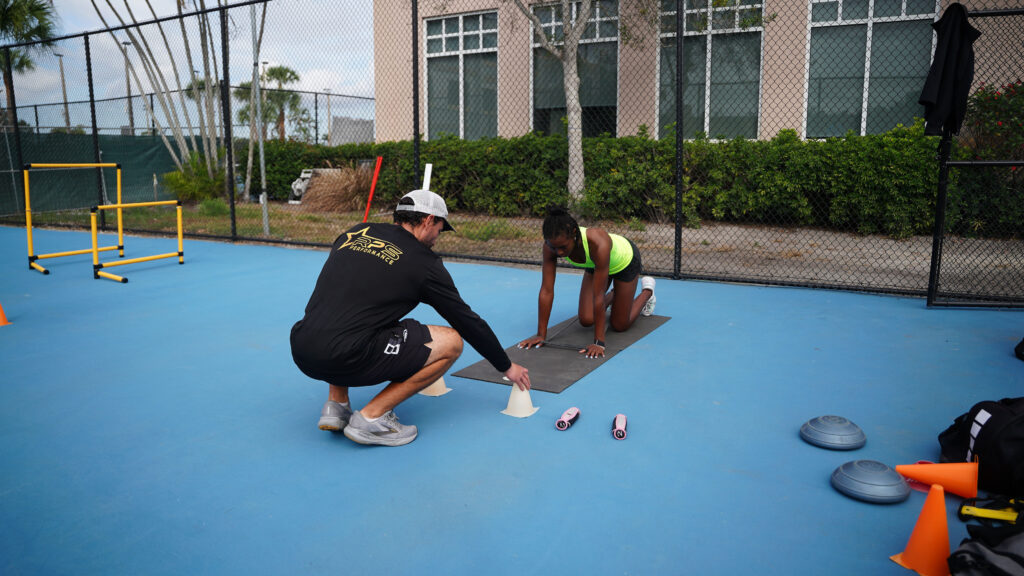
Speed changes games. Agility wins moments. One step faster to a loose ball. One cleaner cut to create separation. One quicker first move to beat a defender. The best part? These athletic qualities aren’t “genetic gifts” reserved for a few—they’re trainable skills when you practice the right patterns, progress them smartly, and stay consistent.
If you’re a student-athlete (or a parent supporting one), this guide gives you a complete, coach-style roadmap: the why, the how, and the exact drills and weekly structure to build real, transferable speed.
Want a coach to evaluate mechanics and build a plan that matches your sport and age?
Contact RPS Academies for a performance assessment.
What speed and agility really mean (and why most training misses the point)
People say “speed” like it’s one thing. It isn’t. Athletic speed is a stack of skills.
Speed (in sports) is usually:
- Acceleration: how fast you reach top speed (first 3–10 steps)
- Max velocity: how fast you move once you’re up to speed (more relevant in track, football wideouts, soccer open-field runs)
- Deceleration: how efficiently you slow down (the hidden skill behind great agility)
- Re-acceleration: how quickly you get back to speed after stopping or cutting
Agility (in sports) is usually:
- Change of direction (COD): planned cuts (shuttle runs, cone drills)
- Reactive agility: unplanned movement based on a cue (opponent, ball, coach signal)
The mistake: doing random cone drills fast without learning to brake, plant, and re-accelerate safely. That kind of training looks athletic, but it often fails to transfer—and can overload knees and ankles.
The win: build mechanics first, then add speed, then add complexity.
The “engine and brakes” principle
If you remember one concept, make it this:
- Acceleration is your engine.
- Deceleration is your brakes.
- Agility is how well you use both—at the right time.
Many athletes train the engine (sprinting) but ignore the brakes (stopping). Then they wonder why they feel “fast” in a straight line but slow in games. Or they cut hard and get sore knees.
You’ll improve fastest by training:
- how to sprint efficiently
- how to stop under control
- how to cut with good angles
- how to react and go
That’s exactly how the drills in this guide are organized.
Who this training is for (and how to use it)
These speed and agility drills work for:
- soccer, basketball, football, baseball/softball, volleyball, lacrosse, hockey, tennis
- any athlete who needs faster first steps, cleaner cuts, and better body control
You don’t need a full gym. You need:
- 10–20 yards of space
- 3–6 cones (or shoes/water bottles)
- optional: a resistance band, mini-hurdles, or agility ladder
How to warm up for speed work (do this every time)
A great speed session starts with a warm-up that prepares joints, raises temperature, and “turns on” coordination.
8-minute warm-up (simple and effective)
- Easy jog or jump rope – 1 minute
- Leg swings (front/back + side/side) – 10 each
- Hip openers – 6 each side
- Ankling / calf pops – 20 yards
- High knees – 20 yards
- Butt kicks – 20 yards
- 2 build-ups – 10 yards at ~70%, then ~85%
Rule: you should feel warm, springy, and ready—not tired.
The 7 drills (with coaching cues, sets, reps, and progressions)
Below are seven foundational speed agility drills. If you do nothing else, pick 4 drills per session (2 speed-focused + 2 agility-focused) and do them well.
Drill 1: Wall Drives (Acceleration Mechanics)
What it builds: powerful first steps, posture, and shin angle
Why it matters: acceleration is about pushing the ground back with the right body angle
Setup
- Hands on a wall, arms straight
- Feet back so your body leans forward
- One knee up at hip height (toe pulled up)
How to do it
- Drive the raised foot down and back like a piston
- Keep hips level and ribs down
- Start slow, then add speed
Coaching cues
- “Tall through the head.”
- “Ribs down, don’t arch.”
- “Push the ground back.”
- “Toe up, heel under hip.”
Sets & reps
- 2–3 sets:
- 10 slow drives each leg
- 10 quick switches
- 10 seconds fast marches
Progression
- Add a resistance band around the waist (partner holds) for more force.
Drill 2: A-March → A-Skip (Sprint Rhythm and Position)
What it builds: coordination, knee lift timing, and foot strike under the hips
Why it matters: the foot should land under you—reaching out in front is like hitting the brakes
Setup
- Open lane 15–20 yards
How to do it
- A-March: march forward with knee up, toe up, foot down under hips
- A-Skip: same pattern, now skipping with rhythm
Coaching cues
- “Toe up.”
- “Knee up.”
- “Step down, don’t reach.”
- “Arms drive cheek-to-hip.”
Sets & reps
- 2 sets A-March (15 yards)
- 2 sets A-Skip (15 yards)
Progression
- Move to faster skips, then transition into a 10-yard sprint.
Drill 3: Falling Start 10-Yard Sprints (First-Step Explosion)
What it builds: game-real acceleration without overthinking mechanics
Why it matters: most sport sprints are 5–15 yards
Setup
- Stand tall, feet hip-width
- Pick a finish line 10 yards away
How to do it
- Lean forward until you “fall”
- The moment you lose balance, explode into a sprint for 10 yards
Coaching cues
- “Push, push, push for the first 3 steps.”
- “Big arms.”
- “Low and go.”
- “Run through the line.”
Sets & reps
- 6–10 reps of 10 yards
- Rest 60–90 seconds (full recovery)
Progression
- Add a reaction cue (coach clap) so the athlete must go instantly.
Drill 4: Snap-Down to Stick (Deceleration Control)
What it builds: braking mechanics, knee/hip alignment, safe landings
Why it matters: most non-contact injuries happen during deceleration and awkward landings
Setup
- Open space, no equipment needed
How to do it
- Start tall on toes, arms overhead
- “Snap down” into an athletic position:
- hips back
- chest proud
- knees tracking over toes
- feet rooted
- Hold the position for 2 seconds
Coaching cues
- “Land quiet.”
- “Hips back like sitting into a chair.”
- “Knees track—don’t cave in.”
- “Brace your core.”
Sets & reps
- 3 sets of 5 reps
Progression
- Snap down → sprint 5 yards → stop and stick.
Drill 5: 5–10–5 Shuttle (Change of Direction Power)
What it builds: lateral cuts, re-acceleration, and body control
Why it matters: this is a classic COD drill that shows whether the athlete can brake and explode
Setup
- 3 cones in a line
- 5 yards between each cone
- Start at the middle cone
How to do it
- Sprint 5 yards right, touch cone/line
- Sprint 10 yards left, touch cone/line
- Sprint 5 yards back through the middle
Coaching cues
- “Lower your hips before the plant.”
- “Plant under your body, not far in front.”
- “Push out of the cut.”
- “Eyes up, chest proud.”
Sets & reps
- 4–8 reps
- Full rest between reps (60–120 seconds)
Progression
- Add a reactive start direction (coach points left/right).
Drill 6: Lateral Bound + Stick (Single-Leg Stability for Cutting)
What it builds: ankle/knee/hip stability, strong landings, lateral power
Why it matters: great cutters “own” the landing, then explode—this drill teaches that control
Setup
- Line on the ground (or imagine one)
How to do it
- Bound sideways from one foot to the other
- Stick the landing for 2 seconds
- Repeat
Coaching cues
- “Land soft, knee stacked.”
- “Hips level.”
- “Don’t rush the stick.”
- “Push the ground away.”
Sets & reps
- 3 sets of 4–6 bounds each direction
Progression
- Remove the stick (faster bounds), or add a quick re-acceleration sprint after landing.
Drill 7: Reactive Mirror Drill (Game-Speed Agility)
What it builds: reaction, footwork, and unpredictable movement
Why it matters: games are not planned cone drills—reactive agility is the separator
Setup
- Two athletes face each other (or athlete faces coach)
- Create a “box” area about 5×5 yards
How to do it
- One person leads (shuffles, short sprints, stops)
- The other mirrors and stays in front for 10–15 seconds
Coaching cues
- “Stay low, chest up.”
- “Short, quick steps.”
- “Don’t cross your feet unless sprinting.”
- “Win the first step.”
Sets & reps
- 6–10 rounds of 10–15 seconds
- Rest 30–60 seconds
Progression
- Add a ball, add a fake, or add a “go” cue where the leader tries to break free.
How to choose the right drills for your sport
Different sports emphasize different speed “flavors.” Use this to prioritize.
Field sports (soccer, football, lacrosse)
- Focus: acceleration, COD, reactive agility
- Prioritize: Falling Starts, 5–10–5, Mirror Drill, Snap-Down
Court sports (basketball, volleyball, tennis)
- Focus: deceleration, lateral movement, re-acceleration
- Prioritize: Snap-Down, Lateral Bound + Stick, 5–10–5, Mirror Drill
Baseball/softball
- Focus: first-step burst, short sprints, lateral reaction
- Prioritize: Falling Starts, A-Skip, Mirror Drill, short reaction sprints
Tip: the best programs don’t “only” train one style. They build a base across all.
What to do each week (simple programming that actually works)
The fastest way to stall progress is doing speed work tired and random. Speed improves when the nervous system is fresh and reps are high-quality.
The two rules of speed programming
- Do speed and agility early in the workout (or on a separate day).
- Rest enough so every rep is fast.
Weekly plan for most youth athletes (2 sessions/week)
Day A (Acceleration + COD)
- Warm-up
- Wall Drives (Drill 1)
- Falling Starts (Drill 3) – 6–8 reps
- Snap-Down to Stick (Drill 4)
- 5–10–5 Shuttle (Drill 5) – 4–6 reps
Day B (Rhythm + Reactive Agility)
- Warm-up
- A-March/A-Skip (Drill 2)
- Short sprint build-ups (2–4 reps of 10–15 yards)
- Lateral Bound + Stick (Drill 6)
- Mirror Drill (Drill 7) – 6–8 rounds
Weekly plan for competitive teens (3 sessions/week)
Day 1: Acceleration emphasis (Drills 1, 3 + short sprints)
Day 2: Braking and COD emphasis (Drills 4, 5, 6)
Day 3: Reactive emphasis (Drills 2, 7 + reaction sprints)
In-season adjustment: keep intensity, reduce volume.
- 1–2 sessions/week
- fewer total reps
- prioritize deceleration and tissue-friendly work
How to progress safely (so speed goes up and injuries go down)
Progression should be small, predictable, and technique-led.
Progression order that works
- Pattern (learn the movement)
- Control (landings and stops look clean)
- Speed (faster reps with the same control)
- Complexity (reaction, multi-direction, sport-like cues)
Two “green light” checks before you speed up
- The athlete can decelerate without knees collapsing inward
- The athlete can sprint with stable posture (no excessive twisting, overstriding, or heel striking far out front)
If either fails, slow down and fix the pattern.
Common mistakes that keep athletes slow (and how to fix them)
Mistake 1: Training speed when exhausted
Why it hurts: fatigue changes mechanics and teaches slow patterns
Fix: put speed work first or separate it from heavy conditioning
Mistake 2: Overstriding (reaching the foot out in front)
Why it hurts: it acts like a brake and stresses hamstrings
Fix: use A-March/A-Skip cues—land under hips, toe up
Mistake 3: Cutting without braking skill
Why it hurts: knee pain, ankle tweaks, poor change-of-direction speed
Fix: master Snap-Down and stick landings before fast shuttles
Mistake 4: Too many reps, not enough rest
Why it hurts: reps get slower and technique falls apart
Fix: full recovery between sprints (quality > quantity)
Mistake 5: Only training ladders and cones
Why it hurts: foot speed improves, but real acceleration/COD doesn’t
Fix: combine mechanics + sprints + braking + reaction
How to measure progress (without over-testing)
Testing is useful when it informs training, not when it becomes the training.
Good baseline tests (every 4–8 weeks)
- 10-yard sprint (acceleration)
- Pro agility 5–10–5 (COD)
- Single-leg lateral bound distance (side-to-side power and control)
- Timed mirror drill rounds (quality and stamina in reactive movement)
How to test well
- Same surface, same shoes, same warm-up
- 2–3 attempts, take best time
- Stop testing if mechanics break down
Progress is often “quiet”: cleaner stops, faster first two steps, less wasted movement.
Where strength training fits (because speed is force)
Speed is not only coordination—it’s also how much force you can put into the ground, fast. Athletes who get stronger (the right way) usually improve speed and COD—especially if they pair strength with sprint mechanics.
A simple pairing that works:
- 2 days/week strength training
- 2 days/week speed/agility training
- Keep at least one full rest day
Even basic strength work (squats, hinges, lunges, calf strength, core bracing) supports faster, safer movement—especially for growing athletes.
Recovery matters more than most athletes think
If speed is nervous-system training, recovery is the multiplier.
Prioritize:
- sleep consistency
- hydration
- protein and carbs around training
- lighter days after intense sprint/COD sessions
If an athlete is constantly sore, their speed sessions will become slower sessions—and progress stalls.
Repurpose idea: social video montage (ready to film)
If you want high-engagement content, film these drills exactly as short clips.
Reel structure (7 clips, 6–10 seconds each)
- Wall Drives: “Fix your first step”
- A-Skip: “Stop overstriding”
- Falling Start: “Explode in 10 yards”
- Snap-Down: “Learn to brake safely”
- 5–10–5: “Cut faster, change direction cleaner”
- Lateral Bound + Stick: “Own the landing”
- Mirror Drill: “React like it’s a game”
Caption prompt
“Save this speed and agility session for your next workout. Quality reps. Full rest. Game-speed results.”
Putting it all together: a 20–30 minute session you can repeat
Here’s a plug-and-play session that works for most athletes.
Warm-up (8 min)
Mechanics (6 min)
- Wall Drives (2 sets)
- A-Skip (2 x 15 yards)
Speed (8 min)
- Falling Start 10-yard sprints (6 reps, full rest)
Agility (8 min)
- Snap-Down to Stick (3 x 5)
- 5–10–5 (4 reps, full rest)
OR Mirror Drill (6 rounds) if you want reactive work
Track one thing each week: faster times, cleaner landings, or better control.
Next step: turn drills into a plan that matches your sport
The difference between “doing drills” and “getting faster” is coaching, progression, and consistency. If you want an athlete-specific plan—based on mechanics, age, sport demands, and injury history—RPS can build it and coach it.
Ready for a structured speed and agility plan?
Contact RPS Academies to get started.
Frequently Asked Questions About “Speed and Agility Training: 7 Drills to Unleash Your Inner Athlete”
1) How often should athletes train speed and agility each week?
Most youth athletes improve quickly with two focused sessions per week, especially when they’re also practicing their sport. Competitive teens can do three sessions if recovery, sleep, and overall workload are managed well. The key is quality: speed work should be done fresh with full rest between reps so mechanics stay sharp. If an athlete is grinding through reps while tired, they’re practicing being slow. A good approach is 2–3 sessions weekly in the off-season and 1–2 sessions in-season to maintain speed.
2) Are speed and agility drills safe for kids and younger teens?
Yes, when drills are taught with good technique, appropriate volumes, and progressive intensity. Younger athletes should focus first on movement quality: posture, coordination, clean landings, and controlled stopping. That’s why deceleration drills like snap-down and stick work are so valuable—they teach the “brakes” that protect knees and ankles. Avoid making sessions into punishment conditioning. Keep sprint distances short, rest fully, and stop if form breaks down. When done properly, these drills can actually reduce injury risk by improving control and joint alignment.
3) What equipment do we need to do these drills at home?
You can do a complete speed and agility session with minimal equipment: a flat 10–20 yard space and a few cones (or shoes/water bottles). Optional tools can add variety—an agility ladder, mini-hurdles, and resistance bands—but they’re not required. The most important “equipment” is structure: a consistent warm-up, clear coaching cues, and enough rest to keep reps fast. If you have access to a field or driveway, you can train acceleration, deceleration, and change of direction effectively without a gym or specialized surfaces.
4) How long does it take to see results from speed and agility training?
Many athletes feel quicker within 2–4 weeks because coordination improves and wasted motion decreases. Measurable changes—faster 10-yard times, sharper cuts, better stopping control—often show up over 6–10 weeks with consistent training. Progress depends on recovery and overall workload: athletes who sleep well and avoid excessive fatigue improve faster. Also, results come from progression, not randomness. Repeating the same drill menu weekly, tracking performance, and gradually increasing speed and complexity (while keeping technique clean) produces the most reliable gains.
5) Do these drills transfer to game speed, or do we need sport-specific work?
They transfer best when you train the underlying skills that games demand: acceleration, braking, cutting angles, and reaction. Planned drills like the 5–10–5 build change-of-direction mechanics, while reactive drills like mirror work teach decision-making and quick first steps under pressure. To maximize transfer, pair drills with sport-specific patterns: defenders backpedal then sprint, basketball athletes shuffle then drive, baseball athletes burst then brake. The goal is not to memorize cone patterns—it’s to build better movement hardware and software that shows up automatically in competition.