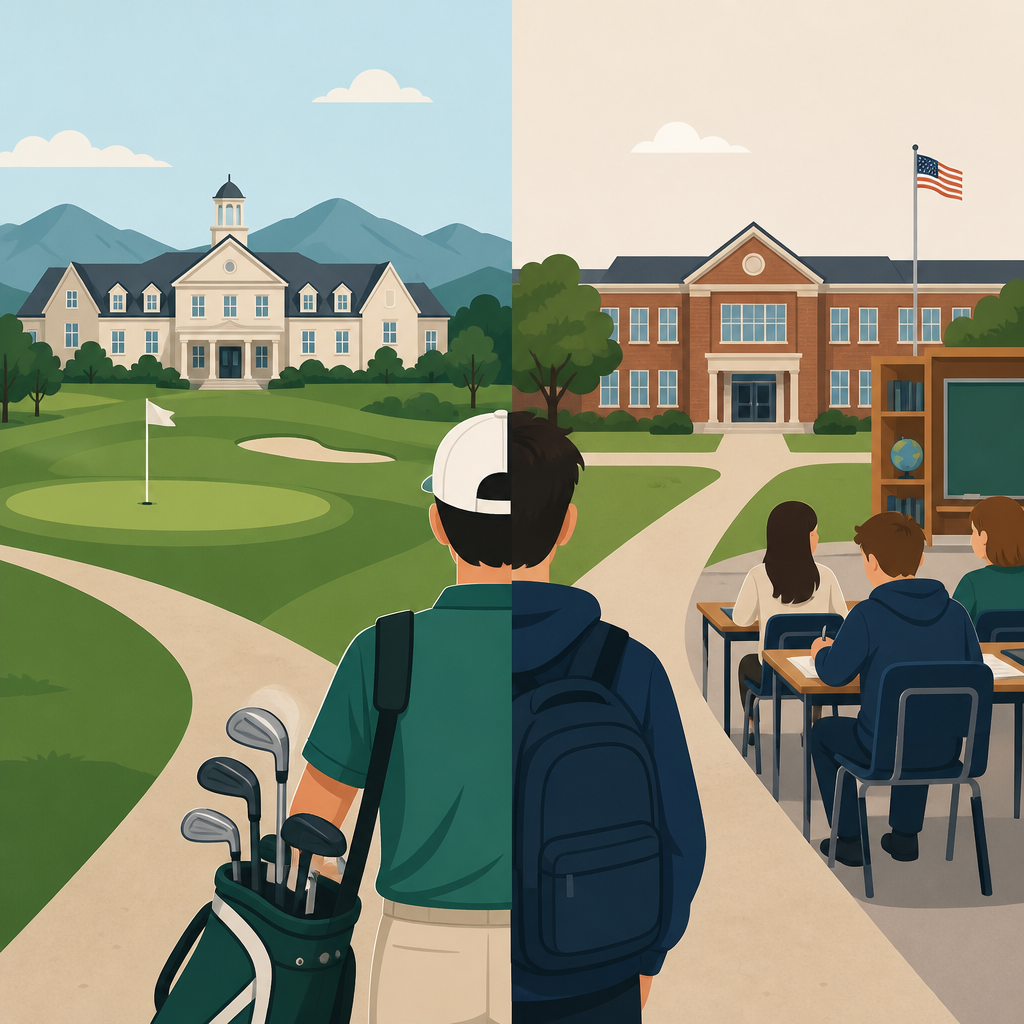
Families comparing a golf boarding school with a traditional high school are usually asking one core question: which environment gives a serious junior athlete the best chance to improve, stay academically on track, and build a realistic college recruiting pathway? A golf boarding school for athletes combines full-time training, structured academics, supervision, and year-round player development in one setting. Traditional high school follows a more common model, with academics first and golf added through school teams, local coaches, and seasonal tournaments.
The distinction matters because junior golf development is unusually sensitive to repetition, weather, coaching access, tournament scheduling, and course management practice. In my experience working with academy athletes and families, the decision is rarely about convenience alone. It is about whether an athlete needs a standard school experience or a high-accountability training environment built around long-term performance. For parents, this also becomes a question of cost, daily structure, safety, and return on investment. For athletes, it is about practice quality, competitive exposure, and whether their current setting is producing measurable improvement.
Golf is different from many school sports because technical progress depends on thousands of precise repetitions, objective swing feedback, short-game volume, fitness, recovery, and access to competition. A talented player can absolutely come from a traditional high school. But when a golfer plateaus due to winter weather, limited school practice, or inconsistent coaching, a full-time academy model becomes worth serious consideration. Florida is central to that conversation because warm-weather training, tournament density, and year-round outdoor access remove many of the interruptions that slow development in colder states.
How the Two Models Actually Work
A golf boarding school is a full-time athlete development environment. The student lives on campus or in supervised housing, completes academics through coordinated schooling options, and trains on a daily schedule that includes swing work, short game, on-course play, strength and conditioning, recovery, and mental training. The structure is intentional. Coaches monitor attendance, workload, tournament calendars, and performance trends, then adjust training plans based on data and direct observation.
Traditional high school usually offers a broader social and extracurricular experience, but golf fits around the school day rather than shaping it. Most players attend classes from morning through afternoon, practice with the school team in season, and then seek private lessons or local tournament play outside school hours. That can work well for disciplined golfers with strong local coaching, nearby year-round facilities, and parents able to manage travel. It becomes harder when training is fragmented across school, club, gym, and tournaments.
The practical difference is integration. In a boarding academy, golf, academics, performance training, meals, supervision, and transportation are planned together. In a traditional setting, families often have to coordinate every moving part themselves.
Training Volume, Coaching Quality, and Skill Development
Serious junior golfers improve fastest when training is both frequent and specific. That means block practice for mechanics, variable practice for adaptability, short-game scoring drills, pressure putting, launch monitor feedback, and on-course decision-making. In a golf boarding school, those pieces are built into the week. Coaches can review swing patterns, track dispersion, assign wedge distance work, and watch whether technical changes hold up on the course.
Traditional high schools rarely provide that level of daily golf-specific support. School teams often have limited practice windows, shared facilities, and coaches responsible for multiple skill levels at once. Some school coaches are excellent, but the model itself is constrained. A two-hour team practice cannot replace a full development system that includes individual lesson plans, sports performance training, and tournament preparation.
One major advantage of a boutique academy is personalized coaching. In smaller training groups, a coach notices ball-flight tendencies, pre-shot routine issues, and course management mistakes much earlier. That matters because junior players do not usually stall from effort alone. They stall from repeating the wrong movement pattern, practicing without intent, or competing without a plan. When coaches can connect technical work to scoring outcomes, progress becomes more measurable.
Golf-specific fitness is another separator. Stronger hips, better thoracic mobility, single-leg stability, and rotational power support swing efficiency and injury prevention. In a traditional school model, strength work may be generic or not tied to golf at all. In a full-time academy, sports performance sessions can support clubhead speed, stamina for multi-round events, and recovery between tournament days.
Academics, Time Management, and Daily Life
Parents often assume traditional high school is automatically safer academically, but that depends on the athlete’s schedule and support system. Many junior golfers miss class for AJGA, regional, or state-level events. When travel increases, a conventional school schedule can become difficult to manage. Make-up work piles up, teachers vary in flexibility, and the athlete is often left balancing school stress with tournament pressure.
At a golf boarding school, academic coordination is part of the operating model. Students still have to do the work, but training and travel are scheduled with school obligations in mind. Supervised study blocks, faculty communication, and structured evening routines reduce the chaos that many traveling athletes experience in traditional schools. This does not make academics easier. It makes them more manageable for athletes with demanding competition calendars.
Daily life also tends to be more consistent in the boarding model. Wake times, meals, training sessions, study hours, recovery, and lights-out expectations create rhythm. That consistency helps younger athletes build habits. In traditional high school, some players handle independence well. Others lose productive hours to commuting, phone distractions, late nights, and unplanned scheduling.
| Category | Golf Boarding School | Traditional High School |
|---|---|---|
| Training schedule | Daily, integrated, golf-first planning | Seasonal or after-school practice |
| Coaching access | Frequent feedback and individualized plans | Varies by school and local resources |
| Academics | Structured around athlete travel and training | Standard school calendar and classroom demands |
| Competition preparation | Built around junior tournament calendars | Often centered on school matches |
| Weather access | Year-round advantage in Florida | May be seasonal in cold climates |
College Recruiting and Tournament Exposure
For scholarship-focused families, recruiting is where the difference becomes most visible. College coaches evaluate scoring history, tournament strength, ranking context, swing repeatability, physical readiness, academic fit, and communication skills. They do not recruit based on passion alone. They recruit players who show a pattern of competitive readiness and upward development.
A golf boarding school can organize development around that reality. Coaches help athletes build tournament schedules, identify when to chase stronger fields, prepare recruiting materials, and understand grade-by-grade milestones. Freshmen and sophomores typically need foundation building, score development, and initial event exposure. Juniors often need a sharper recruiting profile, stronger results, and clearer communication with college programs. Seniors need fit, urgency, and disciplined follow-through.
Traditional high school golfers can absolutely be recruited, especially if they compete heavily outside school. The challenge is that school golf itself is not always the primary evaluation setting for college coaches. Junior tournaments, multi-day events, and national ranking systems often carry more weight. If a family is relying only on the high school season, they may misunderstand how college golf recruiting actually works.
Florida gives academy golfers an important advantage here. The state offers year-round tournament opportunities, quality courses, and regular access to strong competition. That allows players to test their game more often and make adjustments without waiting through a long off-season. More competitive reps generally produce better recruiting evidence than isolated bursts of seasonal play.
Social Development, Independence, and Family Considerations
The best choice is not purely athletic. Parents should also weigh maturity, independence, and emotional readiness. A boarding school for athletes asks more from the student. They must manage shared living, follow rules, communicate with coaches, and recover from setbacks without a parent physically present every day. For some golfers, that environment builds discipline quickly. For others, it is too much too soon.
Traditional high school keeps the athlete closer to family and familiar routines. That can be a major benefit if the player is thriving locally, values school community, and has access to good coaching. It can also be the right short-term choice for a younger golfer who needs another year or two before moving into a full-time training model.
International families have additional factors to consider, including travel logistics, cultural adjustment, English-language academics, and boarding support. A Florida academy with experience guiding international students can reduce that transition burden by coordinating schedules, supervision, and communication in one place. Families should still ask detailed questions about housing, transportation, academics, and student support before making a decision.
When a Golf Boarding School Makes Sense
A golf boarding school usually makes sense when a junior athlete has outgrown the local system. Common signs include winter training limitations, scattered coaching, weak tournament planning, stalled scoring, or constant conflict between school and golf. It also makes sense for athletes targeting college placement who need a more serious daily environment and clearer accountability.
Traditional high school remains a valid path when the golfer has reliable year-round access, strong local instruction, disciplined self-management, and a realistic tournament schedule outside school competition. The key is honesty. If the current setup is not producing improvement in scoring average, ball striking, short-game conversion, fitness, or competitive poise, staying put may feel comfortable but may not serve the athlete’s long-term goals.
The right decision comes down to fit, not image. A golf boarding school offers structure, personalized coaching, and year-round development that many serious players need, especially in Florida’s training environment. Traditional high school offers familiarity, flexibility, and a broader standard student experience. Compare the athlete’s goals, maturity, coaching access, and recruiting timeline against what each model can actually provide. If you are evaluating next steps, start by reviewing your current training week, tournament plan, and academic support system, then speak with an academy admissions advisor about whether full-time golf development is the stronger path.
Frequently Asked Questions
What is the main difference between a golf boarding school and a traditional high school for junior golfers?
The biggest difference is how the student’s daily life is structured around development. At a golf boarding school, golf is not treated as an extracurricular activity that has to fit around everything else. It is built into the student’s schedule alongside academics, strength training, mental performance work, recovery, tournament planning, and supervised study time. That creates a highly organized environment where a serious junior golfer can train consistently, get immediate coaching feedback, and continue progressing throughout the year without constantly trying to balance conflicting school and sports demands.
In a traditional high school, academics usually come first, and golf is typically limited to a seasonal school team, after-school practice, and whatever private coaching or tournament play the family can arrange independently. For some students, that works well, especially if they are self-motivated, have access to strong local coaching, and can manage travel, homework, and competition stress without much structure. But for many aspiring college golfers, the traditional model creates time pressure. Practice hours may be limited, tournament schedules may clash with classes, and development often depends on how much support the family can coordinate outside of school.
So when families compare the two, the real question is not simply which school is better overall. It is which environment better supports a junior golfer’s goals. If the student is aiming for serious year-round improvement and wants academics, coaching, supervision, and recruiting support under one roof, a golf boarding school often offers a more efficient and athlete-centered path. If the student wants a broader conventional high school experience and can still access elite training externally, a traditional high school may still be a good fit.
Does a golf boarding school provide better opportunities for skill development than a traditional high school?
In most cases, yes, especially for students who are trying to reach a high competitive level. A golf boarding school is designed to make improvement systematic rather than occasional. Students usually have regular access to coaches, practice facilities, short game areas, course play, fitness programming, and performance tracking. Because training is part of the weekly routine, players can work on swing mechanics, scoring skills, course management, physical development, and mental toughness in a more complete way than they typically could in a standard high school setting.
Another major advantage is consistency. Golf improvement rarely comes from intense but irregular effort. It comes from doing the right work over time. In a traditional high school, a player might be juggling class schedules, transportation, homework, local team obligations, and limited daylight after school. Even highly committed athletes can end up training in fragments. At a golf boarding school, that fragmentation is reduced. Students are usually able to train year-round, follow a development plan, and get ongoing feedback before bad habits become deeply ingrained.
That said, “better opportunities” only matter if the student is ready to use them. A motivated golfer with excellent private coaching, tournament access, and strong family support can absolutely develop in a traditional high school. But in a golf boarding school, the infrastructure for growth is already in place. For families who want a setting where improvement is built into everyday life rather than dependent on outside coordination, the boarding model generally offers a stronger developmental advantage.
How do academics compare between a golf boarding school and a traditional high school?
This is one of the most important concerns for families, and it is a valid one. Many parents assume that a school focused on athletics may require academic compromise, but strong golf boarding schools are built specifically to avoid that problem. Their model is designed to keep students on track academically while also supporting serious athletic development. That often means structured class schedules, supervised study halls, smaller learning environments, faculty oversight, and built-in accountability. For student-athletes who struggle to manage time independently, that level of structure can actually lead to stronger academic consistency than a traditional high school schedule.
In a traditional high school, students may have access to honors courses, AP classes, clubs, and a wider range of general campus activities. For some families, that breadth is very appealing, and for independent students it can work extremely well. However, junior golfers who travel frequently for tournaments often face missed classes, make-up work, and academic stress that can pile up quickly. Without a coordinated support system, the student may feel like they are constantly catching up. Over time, that pressure can affect both grades and athletic performance.
The best choice depends on the student’s learning style, academic goals, and level of athletic commitment. A golf boarding school can be an excellent fit for students who benefit from routine, close supervision, and a schedule intentionally designed around both classroom progress and golf development. A traditional high school can still be a strong option for students who can manage a heavy workload, advocate for themselves with teachers, and maintain elite training outside the school day. The key is to evaluate not only curriculum strength, but also whether the environment realistically supports the student’s full schedule.
Which option gives a junior golfer a more realistic path to college recruiting?
For a serious golfer, a golf boarding school often creates a clearer and more realistic recruiting pathway because it aligns the three things college coaches care about most: performance, academics, and competitive readiness. Recruiting in golf is not based on potential alone. Coaches want to see tournament results, scoring consistency, physical and mental maturity, solid academics, and a player who understands how to compete at a high level. A golf boarding school is typically set up to support all of those areas at once, while also helping families navigate exposure, scheduling, communication, and long-term planning.
That does not mean attending a traditional high school closes the door to college golf. Many players are recruited from traditional schools every year. But in that model, much of the recruiting process falls on the family to manage. Parents may need to coordinate coaching, tournament selection, video, academic planning, outreach to coaches, and travel logistics on their own. If the player is talented but underexposed, or if the family is unsure how recruiting timelines work, opportunities can easily be missed. The challenge is not just getting good enough. It is making sure the right people see that progress at the right time.
A golf boarding school can make that pathway more organized by surrounding the student with coaches and staff who understand player development and the recruiting landscape. The school environment may also help the athlete build habits college programs value, such as independence, time management, discipline, and resilience. Ultimately, recruiting success still depends on the player’s ability, results, and fit with a college program. But for families looking for a more intentional and guided route, the boarding school model often provides a stronger framework.
How should families decide whether a golf boarding school or a traditional high school is the better fit?
Families should start by being honest about the student’s goals, maturity, and current level of commitment. If the golfer is simply interested in enjoying the game, playing for a school team, and keeping multiple options open, a traditional high school may offer the broader and more familiar experience they want. If the student has clearly stated goals of reaching a high junior level, pursuing college golf seriously, and committing to year-round development, then a golf boarding school may be the more practical environment. The right decision usually becomes clearer when families move beyond the label of the school and focus on whether the student’s daily routine will support long-term success.
It is also important to evaluate the student as a whole person, not just as an athlete. Some students thrive in highly structured, supervised environments and benefit from having training, academics, meals, recovery, and accountability all in one place. Others do better living at home, staying connected to a local community, and developing more independence gradually. Emotional readiness matters. So does academic profile, social fit, financial planning, and the family’s ability to support travel and development if the student remains in a traditional school setting.
The best approach is to compare each option through a practical lens. Ask what the student’s weekly schedule would actually look like, how much quality training they would receive, how academics would be protected, what kind of supervision and mentoring is available, and how college recruiting would be supported. Families who ask those questions usually find that the decision is less about prestige and more about alignment. The best school is the one that gives the student the strongest chance to improve, stay healthy, grow academically, and pursue college golf with a realistic plan.