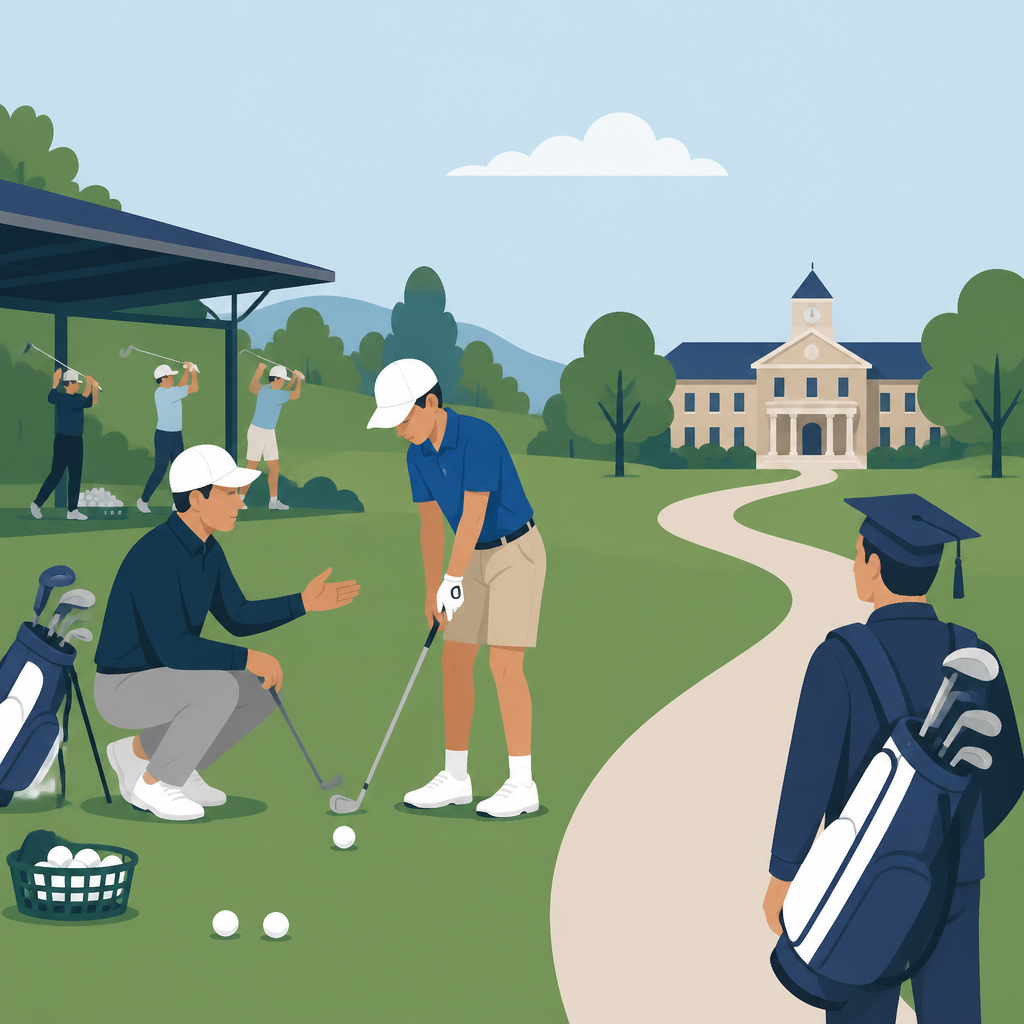
Golf academies help players reach college level by turning scattered practice into a structured development system built around technical training, tournament planning, academics, and recruiting. For junior golfers and their parents, that difference matters because college coaches do not evaluate potential from one good round or a polished swing video alone. They look for scoring consistency, competitive experience, course management, physical readiness, academic stability, and evidence that a player can handle the demands of a college program.
A golf academy is a full-time or high-frequency training environment where coaches coordinate instruction, strength and conditioning, mental training, tournament scheduling, and school support. In a strong boarding school setting for athletes, the golf program does not operate in isolation. It connects practice habits to tournament performance, recruiting goals, and daily routines. That integration is one reason many families choose academy training over piecing together lessons, local practice, and travel tournaments on their own.
We have worked with junior golfers who arrived with talent but no plan. Some hit the ball well on the range but struggled to post scores under pressure. Others played limited schedules because weather restricted access in colder states. In Florida, year-round outdoor training changes that equation. Players can train consistently, compete more often, and build measurable progress over months instead of losing momentum each winter.
Parents usually ask the same practical questions. What does a golf academy actually improve? Is full-time training worth the investment? How do academics fit around travel? When should recruiting start? Those are the right questions, because the college pathway in golf rewards long-term organization more than last-minute exposure. A good academy helps players improve swing mechanics, short game, driving distance, iron accuracy, recovery habits, and decision-making, but it also helps them build the tournament resume and recruiting profile college coaches expect.
What College Golf Coaches Actually Look For
College golf recruiting starts with performance, not branding. Coaches review scoring averages, tournament fields, rankings, ball-striking quality, short-game reliability, and how a player competes over multiple rounds. They also look at transcript strength, communication habits, work ethic, and whether the athlete fits the program culture. A player who shoots one low number but follows it with inconsistent rounds is harder to project than a player who steadily posts competitive scores on demanding courses.
For that reason, golf academies focus on repeatable habits. Coaches track dispersion patterns, greens in regulation, up-and-down percentages, three-putt frequency, and penalty strokes. Those numbers tell a clearer story than range sessions alone. If a junior golfer loses four shots per round from poor wedge distance control, that problem is trainable. If the issue is course management, coaches can address club selection, target discipline, and decision-making under tournament pressure.
Recruiting also depends on context. A score of 74 means more when it comes on a championship course in windy conditions against a strong field. Academy coaches help families choose events that provide useful exposure without overloading the schedule. That protects development and gives coaches credible data when they speak with college programs.
How Structured Daily Training Produces Better Scores
The biggest advantage of a golf academy is structure. Many juniors practice hard, but not efficiently. They spend too much time hitting full swings and too little time on scoring clubs, pressure drills, recovery, and competitive simulation. At academy level, each training block has a purpose. One session may target driver face control and launch conditions. Another may focus on wedge ladders, bunker exits, and putts inside eight feet. A third may center on on-course management and post-round analysis.
That structure matters because college golf is a scoring environment. Swing changes are only valuable if they hold up on the course. We regularly see players improve faster when technical instruction is paired with immediate transfer work. After a lesson, they do not just hit another bucket. They complete task-based drills, play holes with constraints, and measure outcomes. The goal is to connect mechanics to decisions and decisions to scores.
Florida strengthens this process. Year-round access means players can train outdoors consistently on grass, not only indoors on mats or simulators during winter months. They can work on uneven lies, grainy greens, wind control, and heat management. Those are real competitive variables in junior and college golf. Consistent outdoor reps accelerate adaptation.
| Development Area | Academy Focus | College-Level Benefit |
|---|---|---|
| Swing mechanics | Video analysis, launch monitor feedback, supervised drills | More reliable ball flight and distance control |
| Short game | Wedge matrix, bunker practice, pressure putting games | Lower scoring and better recovery around greens |
| Course management | On-course strategy sessions and post-round review | Smarter decisions and fewer penalty strokes |
| Sports performance | Strength, mobility, stability, and recovery planning | More speed, stamina, and injury resistance |
| Mental training | Pre-shot routines, breathing, reset skills, reflection | Better composure in tournament pressure |
| Recruiting support | Tournament scheduling, video, emails, profile guidance | Stronger visibility with college coaches |
Why Short Game, Course Management, and Mental Training Matter Most
Families often assume college-level golf is mainly about swing aesthetics or raw distance. Distance helps, but scoring travels through the short game and decision-making. Academy coaches know that a player who can chip, pitch, lag putt, and avoid doubles will beat a longer hitter who wastes shots around the green. That is why serious training plans devote substantial time to wedge windows, spin control, green-reading, bunker patterns, and pressure putting.
Mental training is equally important. Junior golfers face long rounds, individual accountability, and little time to hide mistakes. One poor swing can affect the next three holes if a player lacks reset skills. In academy settings, mental work becomes part of daily preparation. Players build pre-shot routines, learn how to respond to bad breaks, and review rounds without emotional overreaction. These habits are practical, not abstract. They directly influence scoring consistency.
Course management is another separator. College coaches value players who understand when to attack and when to play away from trouble. A junior golfer might have the ability to carry a bunker, but if the miss leaves a short-sided recovery and a penalty area nearby, the smarter play may be different. Academy coaches teach conservative targets, dispersion awareness, and strategy based on actual percentages rather than optimism.
Sports Performance, Recovery, and Injury Prevention in Golf Development
Golf is technical, but college-ready golfers also need physical capacity. They walk multiple rounds, maintain posture under fatigue, create speed efficiently, and recover between training days and tournaments. A quality golf academy integrates sports performance training with the swing program. That usually includes mobility, rotational strength, single-leg stability, power development, core control, and movement screening.
This matters because physical limitations often show up as swing flaws. Restricted thoracic rotation can reduce backswing freedom. Poor hip stability can affect balance and sequencing. Limited endurance can lead to late-round decision errors and ball-striking drop-off. When strength and conditioning coaches work closely with golf staff, the player receives a more accurate plan. The goal is not bodybuilding. It is golf-specific performance.
Recovery deserves equal attention. Sleep, hydration, fueling, and tournament-week workload management affect scoring more than many families realize. We encourage players to treat recovery as part of training, not a luxury. The juniors who improve steadily are usually the ones with the best routines, not only the most talent.
How Golf Academies Support Academics and Boarding Life
Reaching college level requires academic eligibility as well as golf skill. That is why the right academy coordinates schooling options, study time, travel planning, and communication with families. For boarding students, structure is especially valuable. A predictable daily schedule reduces wasted time and helps athletes handle practice, strength work, coursework, and tournament travel without constant last-minute stress.
Parents should evaluate whether an academy treats academics as a real operating priority. Players need time for assignments, exam preparation, and recovery after travel. They also need adults who monitor workload and adjust when tournament demands increase. In a boutique academy environment, personalized oversight is easier. Athletes are less likely to get lost in the system, and families receive clearer updates.
International students often benefit even more from this setup. They may be adapting to U.S. schooling expectations, tournament formats, and college recruiting norms at the same time. An academy that understands international family concerns can make the transition smoother through structured communication, academic coordination, and practical guidance on daily life in Florida.
How Academy Coaching Connects to College Recruiting
Golf instruction alone does not create recruiting opportunities. Players need a timeline. Freshmen and sophomores should build fundamentals, establish competitive habits, and begin tracking results. By junior year, most serious prospects need a stronger tournament resume, a clear player profile, and direct communication with coaches. Seniors often focus on fit, follow-up, and final evaluation periods.
Academies help because they see the full picture. Coaches can advise on tournament selection, scoring goals, swing readiness, and how a player should present to programs at different levels. They can help families build a recruiting profile with academic information, results, swing video, and a tournament schedule. They can also guide recruiting emails so coaches receive concise, useful information instead of vague introductions.
Just as important, academy coaches bring honesty. Not every player is on the same path, and not every college program is the right fit. Families need realistic feedback on level, timeline, and where development must improve. That clarity saves time and keeps expectations grounded in evidence.
Choosing the Right Golf Academy in Florida
Not every academy offers the same value. Parents should look closely at coaching access, player-to-coach ratio, on-course instruction, tournament planning, sports performance support, academic coordination, and how progress is measured. Ask how often coaches review scoring data, how they individualize development plans, and how they balance technical work with competitive play. If every player follows the same template, the program is too broad for serious recruiting preparation.
Florida remains a strong choice because climate, competition density, and recruiting visibility support year-round development. Players from cold-weather states often make faster gains once they can train and compete consistently outdoors. A boutique academy can make that advantage more personal by giving each golfer direct feedback, individualized planning, and a daily environment built around complete athlete development.
Golf academies help players reach college level when they combine technical instruction, short-game training, sports performance, mental preparation, academics, and recruiting support into one clear system. That is the real benefit. Players improve faster because every part of development points toward scoring, tournament readiness, and college placement. Parents gain transparency, and athletes gain structure.
If you are comparing full-time training options, start by reviewing how a program handles daily schedules, tournament planning, academic support, and recruiting guidance. Then ask whether the environment fits your athlete’s goals. Learn more about the RPS Golf Academy approach and request information on admissions, boarding life, and player development planning.
Frequently Asked Questions
How do golf academies improve a junior player’s chances of competing at the college level?
Golf academies improve a player’s college prospects by replacing inconsistent, unplanned practice with a structured development system. That system usually includes technical swing work, short-game training, on-course strategy, physical conditioning, mental performance, tournament scheduling, and academic accountability. For families pursuing college golf, this matters because coaches are not simply looking for talented swings. They are evaluating whether a player can score consistently, compete under pressure, manage the golf course intelligently, maintain steady academic performance, and continue improving over time.
In many cases, a talented junior golfer practices hard but without enough direction. One week may focus heavily on mechanics, another on tournament play, while fitness, recovery, or course management get ignored. Golf academies help organize all of those moving parts into a long-term plan. Players receive clearer benchmarks, more regular feedback, and a more complete picture of what college coaches actually want to see. Instead of chasing quick fixes, they begin building a competitive profile that reflects readiness for college golf.
Another major advantage is accountability. Players are expected to train with purpose, track performance, and learn from tournament results rather than just moving on to the next event. Over time, this creates more maturity, discipline, and consistency, which are all qualities college programs value. In short, golf academies do not guarantee recruitment, but they often give serious players a stronger path by helping them develop the skills, habits, and competitive record needed to be taken seriously by college coaches.
What do college golf coaches look for beyond a good swing or a low score in one tournament?
College coaches evaluate much more than raw talent. A polished swing can create a strong first impression, but recruiting decisions are usually based on patterns, not isolated moments. Coaches want to see scoring consistency over time, competitive results in credible events, the ability to handle pressure, smart decision-making on the course, and signs that a player can contribute within a team environment. They also pay close attention to academic performance, since eligibility, classroom discipline, and time management are all part of succeeding in college athletics.
Golf academies can help players understand this broader evaluation process. For example, a player may look technically sound on video but still struggle with tournament management, emotional control, or decision-making under pressure. Coaches notice those gaps. They want athletes who avoid big mistakes, recover well after poor holes, and show the mental steadiness needed for multi-round competition. They also value players who continue to develop physically and mentally, rather than those who peak early and plateau.
Recruiting is also about fit. Coaches want players who are coachable, reliable, and realistic about their level. A golf academy often helps families better understand where a player fits within the college landscape, whether that means Division I, Division II, Division III, NAIA, or junior college options. By focusing on the full picture rather than a highlight reel, academies help players present themselves as complete student-athletes instead of prospects built around one impressive scorecard or swing sequence.
Can golf academies help with tournament planning and building a stronger recruiting profile?
Yes, and this is one of the most valuable ways a golf academy can influence a player’s path to college golf. Tournament planning is not just about entering as many events as possible. It is about choosing the right events at the right time based on a player’s current level, development stage, scoring goals, travel demands, and recruiting objectives. A thoughtful tournament schedule helps players gain meaningful competitive experience while avoiding burnout, poor preparation, and unnecessary gaps in development.
Academies often guide players toward events that provide stronger competition, better ranking opportunities, or better exposure to college coaches. Just as importantly, they help players prepare for those events with purpose. That includes practice blocks tailored to upcoming course conditions, performance reviews after tournaments, and adjustments based on actual scoring trends. Over time, this creates a more credible competitive record. Coaches are much more interested in sustained performance across recognized events than in scattered results with no clear progression.
Building a recruiting profile also involves presenting the right information clearly and professionally. A strong profile may include academic details, tournament results, scoring averages, swing and tournament video, a player résumé, and communication with coaches. Golf academies often support this process by helping players identify realistic target schools, organize performance data, and communicate in a way that reflects seriousness and maturity. That guidance can reduce confusion for families and help players avoid common recruiting mistakes, such as overestimating fit, contacting schools too late, or relying only on highlight content instead of real competitive evidence.
Why are academics and time management so important in the college golf recruiting process?
Academics are a core part of college golf recruiting because every recruited player is a student-athlete first. Even highly talented golfers must meet admissions and eligibility standards, and many coaches prefer players who show dependable classroom habits. Strong grades and academic stability signal discipline, responsibility, and the ability to handle the demands of college life. A player who cannot manage school alongside training and travel may struggle in a college program, no matter how much talent they have.
Golf academies that support college-bound players often emphasize structure beyond the practice tee. That can include supervised study time, academic monitoring, progress checks, and routines that teach players how to balance lessons, workouts, tournament preparation, travel, and schoolwork. This matters because college coaches want athletes who can handle packed schedules without falling behind. Tournament golf already requires organization and maturity, and those same qualities carry directly into college success.
Time management also affects performance. Players who are constantly stressed, rushed, or academically behind often struggle to train effectively or compete with a clear mind. By helping students develop stronger daily habits, golf academies can improve both academic and athletic outcomes. For parents, this is especially important because the goal is not just getting recruited, but being prepared to stay eligible, contribute to a team, and thrive once on campus. In that sense, academic structure is not separate from golf development; it is part of the same preparation process.
Is attending a golf academy necessary to earn a college golf opportunity?
No, attending a golf academy is not strictly necessary to play golf in college. Many players reach the college level through private coaching, strong family support, local tournament play, and self-driven development. However, a golf academy can be a major advantage for players who need more structure, more consistent feedback, better access to competitive planning, or a clearer recruiting roadmap. The real question is not whether an academy is required, but whether a player’s current environment is strong enough to support college-level development across all the areas coaches evaluate.
For some juniors, the existing support system already works well. They may have excellent instruction, disciplined practice habits, solid tournament access, and strong academic routines. For others, progress stalls because training is fragmented, tournament choices are inconsistent, or there is no long-term plan connecting skill development to recruiting goals. In those cases, a golf academy can help bring clarity and direction. It can also expose players to a more competitive environment, where they train alongside other serious juniors with similar goals.
Families should evaluate an academy based on fit, not marketing promises. Important factors include coaching quality, player development philosophy, communication, academic support, tournament guidance, and track record with long-term improvement. A good academy should help a player become more complete, more accountable, and more realistic about the path ahead. It is not a shortcut, and it does not replace hard work. But for the right player, it can be a highly effective environment for turning potential into the kind of consistent performance that leads to real college opportunities.