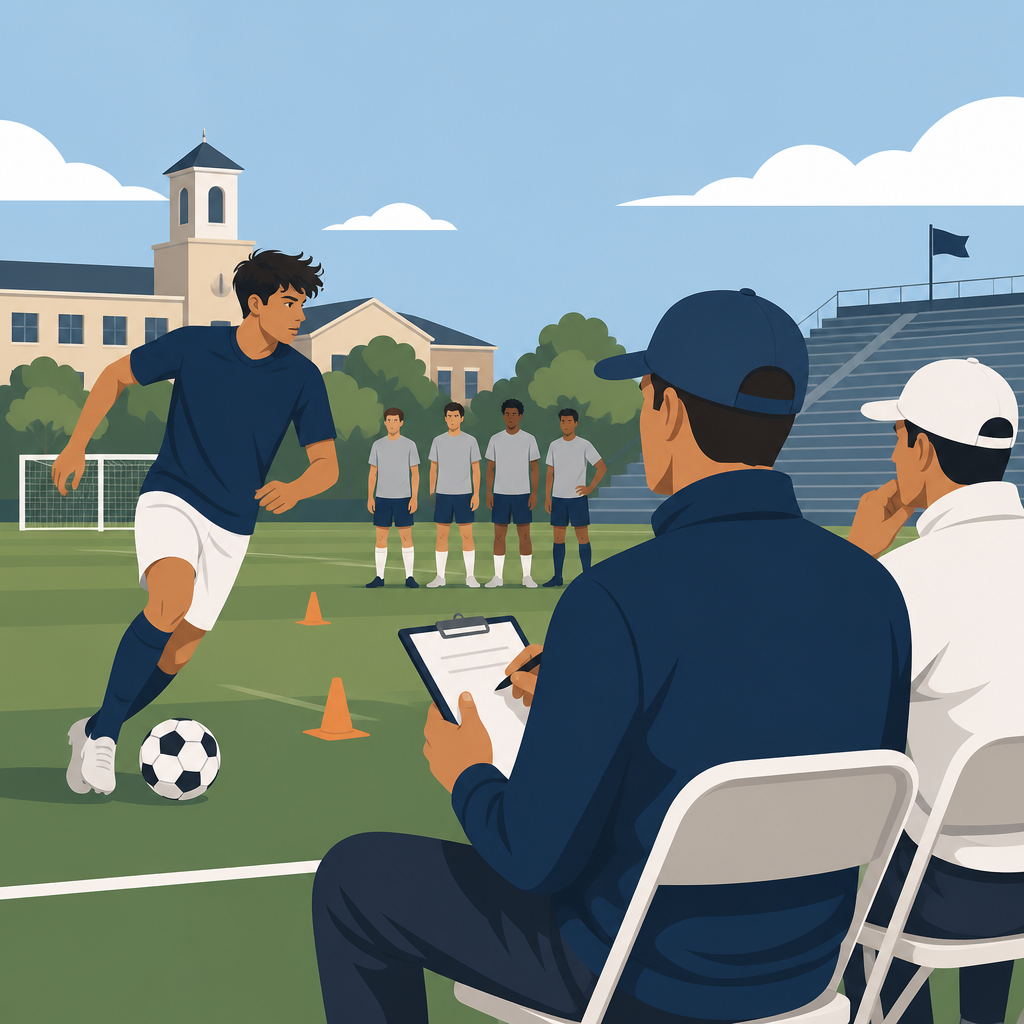
Getting noticed by college soccer coaches starts long before a highlight video or showcase event, because recruiting is really the result of years of visible development, consistent communication, and smart planning. For serious junior athletes and their parents, the process can feel confusing. Terms like recruiting profile, ID camp, NCAA contact rules, transcript review, and highlight video standards get used constantly, but few families see how those pieces fit together into one workable plan.
College soccer recruiting is the system coaches use to identify, evaluate, and communicate with prospects who can help their program. In practical terms, coaches look for three things at once: playing level, academic fit, and character. They want athletes who can solve problems on the field, handle the speed of college training, and stay eligible in the classroom. That is why recruiting is never just about talent. It is about timing, exposure, and proof.
We have worked with families who assumed coaches would simply find a strong player through tournament results alone. That rarely happens consistently. Coaches have limited travel budgets, crowded evaluation calendars, and hundreds of emails in their inbox. If you want to stand out, you need a structured recruiting process that makes evaluation easier for the coach. That means building a complete profile, competing in the right environments, and showing improvement over time.
For soccer players training in Florida, there is a clear advantage. Year-round outdoor training, strong showcase density, and regular access to competitive match play create more evaluation opportunities than seasonal environments usually provide. A boutique academy setting can also help because coaches and staff know the athlete well enough to guide scheduling, video, academics, and communication in a personalized way. That combination matters when college coaches are deciding which prospects deserve their limited attention.
Understand what college soccer coaches actually evaluate
College coaches do not recruit from a single checklist, but their evaluation patterns are consistent. First, they assess whether a player can compete at the level of the program. That includes technical ability, tactical awareness, speed of play, first touch, movement off the ball, defending habits, and decision-making under pressure. Position matters. A center back is judged differently than a winger, and a goalkeeper is evaluated through command, distribution, and shot-stopping, not highlight goals.
Second, coaches study context. They want to know the level of competition, the player’s club environment, physical profile, graduation year, and consistency across full matches. One great clip means very little if the player disappears for 70 minutes. Third, they evaluate academics and behavior. Admissions standards vary by school, but grades, course rigor, and test requirements can all affect whether a coach can support a recruit. Coaches also pay attention to body language, coachability, and communication with adults.
Parents often ask what gets a player ruled out quickly. Common reasons include poor academic records, vague emails, outdated film, unrealistic school lists, and weak competition schedules. Another major issue is lack of self-awareness. If a player targets only top programs without matching the athletic profile those coaches recruit, the process stalls. Strong recruiting plans start with honest evaluation, not wishful thinking.
Build a recruiting profile that answers a coach’s first questions
A recruiting profile should let a coach understand the athlete in less than two minutes. At minimum, include full name, graduation year, primary and secondary positions, height, dominant foot, club team, coach contact, GPA, test information if relevant, and citizenship status for international students. Add a short player summary that explains style of play clearly. “Box-to-box midfielder with strong pressing range and line-breaking passing” tells a coach more than “hard worker and team player.”
Video must be central to the profile. Lead with a short highlight video, usually three to five minutes, and make sure each clip identifies the player before the action begins. Then provide links to full-match film. Coaches use highlights to decide whether to keep watching, but full games show tactical discipline, transition reactions, communication, and consistency. If the player is a defender or holding midfielder, full-match footage is especially important because many of the best actions are subtle and not dramatic.
Email is the delivery system. A strong first email should be brief, personalized, and specific. Mention why the school is a genuine fit, include upcoming tournament dates, and link the profile and film directly. Do not attach huge files. Do not write a long family biography. Coaches want quick access to relevant information and a reason to continue the conversation.
| Recruiting Asset | What It Should Include | Why Coaches Care |
|---|---|---|
| Player profile | Bio, position, academics, club details, contact information | Gives fast baseline context |
| Highlight video | Three to five minutes, labeled clips, best actions first | Helps coaches make an initial evaluation |
| Full-match video | Complete games against strong opponents | Shows consistency, positioning, and decision-making |
| Email outreach | Personalized note, schedule, links, fit statement | Makes follow-up easy and professional |
| Academic record | GPA, course load, school information | Confirms admissions viability |
Compete where coaches are watching
Exposure matters, but random exposure is inefficient. College coaches usually recruit through club showcases, major tournaments, league play they trust, ID camps, referrals, and repeated video review. The key is to play in environments where your level is clear. A weaker event with easy domination may look good to family members but gives coaches little useful information. Competitive matches against strong opponents create better recruiting evidence.
For many families, the smartest path is not attending every possible event. It is selecting events that match realistic target schools. If a player projects as a strong Division II or NAIA recruit, the schedule should include events those coaches attend, not only high-profile showcases stacked with Power Four programs. Recruiting success often improves when the event plan reflects fit instead of status.
Florida gives soccer players an edge here. With year-round training and a dense competition calendar, athletes can build continuity instead of losing months to weather interruptions. Coaches also travel to Florida regularly because they can evaluate multiple teams efficiently in one trip. That concentration of competition creates more chances to be seen live, especially when video outreach supports the schedule.
ID camps can help, but only when chosen carefully. The best camps are tied to schools that already fit the player academically and athletically, or to reputable events with a strong coach turnout. A camp is not a shortcut. It is one evaluation setting among many. If a player arrives unfit, unprepared, or without prior communication, the camp rarely changes recruiting outcomes positively.
Use a grade-by-grade recruiting timeline
Freshman year should focus on development, academics, and baseline organization. Players need quality training, competitive match film, and a realistic understanding of level. This is a good time to start a simple player profile and track schedules, but the main goal is improvement. Sophomore year is when outreach usually becomes more intentional. Video should improve, school lists should narrow, and families should learn NCAA, NAIA, and junior college pathways.
Junior year is often the most important phase. Coaches accelerate evaluations, ask for transcripts, and monitor communication consistency. This is the time for targeted emails, updated film, campus visits, and stronger follow-up after showcase events. Senior year becomes about closing options, staying eligible, and managing timing. Some players commit early, while others find strong opportunities later through continued performance and organized communication.
International families need an additional layer of planning. Coaches may ask about academic conversion, English proficiency, graduation equivalency, and visa logistics at a high level. Families should be ready with translated records when needed and should understand that coaches value clarity. The easier you make academic review, the easier it is for a coach to advocate internally.
Stand out through development, not just promotion
Promotion gets attention, but development keeps it. Coaches return to prospects who improve physically, technically, and tactically over time. That is why full-time academy training can make a meaningful difference for the right player. In a structured environment, athletes train year-round, review film regularly, build speed and endurance, and work on position-specific habits with consistent feedback. Improvement becomes visible and measurable.
In soccer, noticeable development often shows up in small details. A fullback learns when to invert or overlap. A striker improves pressing angles and movement between center backs. A midfielder receives on the half-turn more often and plays forward earlier. These are the changes college coaches trust because they translate to the college game better than flashy but isolated moments.
We also see recruiting improve when athletes treat academics, recovery, and communication as part of player development. Coaches notice the athlete who answers emails professionally, maintains grades during travel, and competes with steady body language after mistakes. Those habits reduce risk for the program. In a crowded recruiting pool, lower-risk athletes often move up the board.
Make parents part of the process without putting them in front of it
Parents play a major role in college soccer recruiting, especially when coordinating travel, transcripts, scheduling, and financial planning. That support is valuable. At the same time, coaches want to hear the player’s voice. The athlete should send the email, ask the question on a call, and lead the campus conversation when possible. Independence signals maturity.
Families should also understand the financial side clearly. Scholarship opportunities in college soccer vary widely by division, roster construction, and institutional budget. Partial athletic aid, academic merit aid, and need-based aid may all be part of the final package. No serious program should promise guaranteed outcomes. Instead, focus on fit, development, and honest communication about affordability.
The strongest next step is simple: build your recruiting profile, update your film, create a realistic school list, and compete in front of the right coaches. If you want more structure, learn how our soccer academy approach supports player development, recruiting timelines, and year-round preparation in Florida.
Frequently Asked Questions
1. What do college soccer coaches actually look for when deciding which players to recruit?
College soccer coaches are not just looking for the player with the flashiest highlight reel or the most goals. They are evaluating the complete athlete over time. That includes technical ability, tactical understanding, speed of play, work rate, decision-making, coachability, athleticism, consistency, and how a player performs in real match situations. Coaches also pay close attention to positional fit. A center back, for example, may be judged more on organization, composure, recovery speed, and aerial ability than on scoring. A midfielder may be evaluated for vision, awareness, movement off the ball, and ability to connect play under pressure.
Just as important, coaches recruit for their specific roster needs. A very talented player may not be a priority if a program already has depth at that position for the next two years. On the other hand, a player who fits a clear need and matches the team’s style of play may draw serious interest even without national-level attention. Coaches are also assessing whether a prospect can handle the academic expectations of the school, meet admissions standards, and represent the program well. Character matters. Body language, competitiveness, resilience after mistakes, and interaction with teammates and staff all influence recruiting decisions.
In practical terms, getting noticed means showing sustained development, not one great weekend. Coaches want to see players competing against strong opposition, improving over time, and performing in environments that resemble the college game. Families should think beyond exposure alone and focus on building a profile that demonstrates ability, maturity, academic readiness, and fit. The players who stand out most are usually the ones who combine talent with consistency, communication, and clear evidence that they can contribute to a college program.
2. When should players start the college soccer recruiting process, and what should they do first?
The recruiting process should begin earlier than many families expect, but that does not mean freshmen need to panic. The smartest approach is to think of recruiting as a multi-year progression. In the early high school years, the main goal is not aggressive self-promotion. It is building the foundation coaches will eventually evaluate: strong academics, steady athletic development, quality match footage, and a realistic understanding of playing level. Players should also begin learning how the college soccer landscape works, including differences between NCAA Division I, Division II, Division III, NAIA, and junior college pathways.
One of the best first steps is creating a simple but complete recruiting profile. That profile should include graduation year, position, height, weight, dominant foot, club team, high school team, coach contact information, academic information, test scores if available, intended major interests, and a short player summary. Families should also start tracking schedules, tournament appearances, and game film. Even before coaches can actively engage in certain ways under NCAA contact rules, athletes can still research programs, attend camps, fill out recruiting questionnaires, and send introductory emails. Early organization makes the process far easier later.
Academics should be treated as a recruiting tool from the beginning. Coaches want players who can clear admissions and stay eligible. A transcript review can become extremely important, especially at academically selective schools. If a player waits too long to address grades, course selection, or testing, that can reduce options. Starting early allows families to target schools more effectively, identify realistic fit, and avoid wasting time on programs that do not match the athlete’s level or academic profile. The first stage of recruiting is really about preparation, education, and visibility, not just exposure.
3. How important are highlight videos, and what makes a soccer recruiting video effective?
Highlight videos are important, but they are often misunderstood. A good video does not replace live evaluation, and it should not be treated as the entire recruiting strategy. Its main purpose is to help a coach quickly decide whether a player is worth tracking further, watching in full-game film, or seeing in person. In other words, a highlight video is usually the introduction, not the final proof. Coaches are busy and make quick judgments, so the structure and clarity of the video matter a lot.
An effective soccer recruiting video should begin with the player’s basic information on screen, including name, graduation year, position, jersey number, team name, and contact information. Each clip should clearly identify the athlete before the action starts, either with an arrow, spotlight, or freeze frame. The best videos show moments that translate to the college game: first touch, passing range, defensive awareness, movement off the ball, pressing, recovery runs, combination play, finishing, and decision-making under pressure. Position-specific value is critical. Goalkeepers, defenders, midfielders, and forwards should each emphasize the actions coaches care about most for that role.
Quality matters more than flashy editing. Coaches generally prefer short, efficient videos that get to the point quickly. Overly long intros, music-heavy edits, dramatic transitions, and repeated clips can work against a player. Full-game footage is also very valuable because it shows habits, work rate, positioning, and consistency beyond isolated highlights. Ideally, players should have both a highlight video and access to complete match film. The strongest approach is to update video regularly, send coaches direct links, and pair that video with a thoughtful email that includes upcoming schedules. A video opens the door, but clear communication and verified performance are what move recruiting forward.
4. Do ID camps and showcase events really help players get noticed by college soccer coaches?
ID camps and showcase events can be extremely helpful, but only when chosen strategically. These events are not automatic recruiting shortcuts. Their value depends on who will be there, whether the player is a realistic fit for those programs, how prepared the athlete is to perform, and whether coaches have already been contacted in advance. Many families spend significant money on camps and showcases without a clear plan, and that often leads to disappointment. Exposure works best when it is targeted, not random.
An ID camp is most useful when a player already has genuine interest in the host school or when the attending staff closely matches the athlete’s academic and playing profile. It gives coaches a chance to evaluate personality, coachability, responsiveness to instruction, and how a player handles the speed and demands of that environment. Showcase events can be valuable because multiple college coaches may watch in one setting, but athletes should remember that coaches often arrive with a list of players they already intend to evaluate. That is why pre-event communication matters so much. If a coach knows when and where a player will be competing, the chances of being seen improve significantly.
Families should assess events based on fit, level, cost, timing, and coaching attendance. Not every event is worth attending. A player who is not yet physically or technically ready for a major exposure event may benefit more from additional development first. It is also important to follow up after camps and showcases. A strong event without follow-up can lose momentum quickly. The best results usually come when a player sends coaches a short email beforehand, competes well, and then follows up with thanks, updated film, and future schedules. Camps and showcases are tools, not guarantees, and they work best within a larger recruiting plan built on communication and long-term development.
5. How should players communicate with college soccer coaches, and what mistakes should they avoid?
Communication is one of the biggest factors in getting noticed, because coaches often respond to players who are proactive, organized, and genuinely interested in their program. The best communication is personal, concise, and consistent. A player should not send a generic mass email to dozens of coaches with no customization. Instead, each message should show that the athlete has researched the school and understands why it could be a good fit academically, athletically, or culturally. An introductory email should include basic player information, academic details, club team, position, graduation year, links to video, and a schedule of upcoming games or events.
Players also need to understand NCAA contact rules and the differences between divisions, because those rules affect how and when coaches can respond in certain ways. Even when direct recruiting conversations are limited, athletes can still express interest, complete questionnaires, visit campuses, and send updates. Families should not interpret limited early response as rejection. Coaches may be restricted, busy, or still evaluating roster needs. What matters is maintaining professional communication over time. Updates should be meaningful, such as a new transcript, improved test scores, updated video, a tournament schedule, or a major performance note.
The most common mistakes include emailing coaches too late, sending incomplete profiles, failing to include video, not proofreading messages, overestimating playing level, and relying entirely on club coaches to manage the process. Another frequent problem is poor follow-through. If a coach replies with questions, requests film, or asks for academic information, prompt response matters. Families should also avoid being passive. Recruiting rarely works well when players wait to be discovered. The athletes who create momentum are usually the ones who communicate respectfully, stay organized, and continue building relationships over time. Strong communication does not mean being pushy. It means being clear, prepared, responsive, and intentional throughout the recruiting journey.