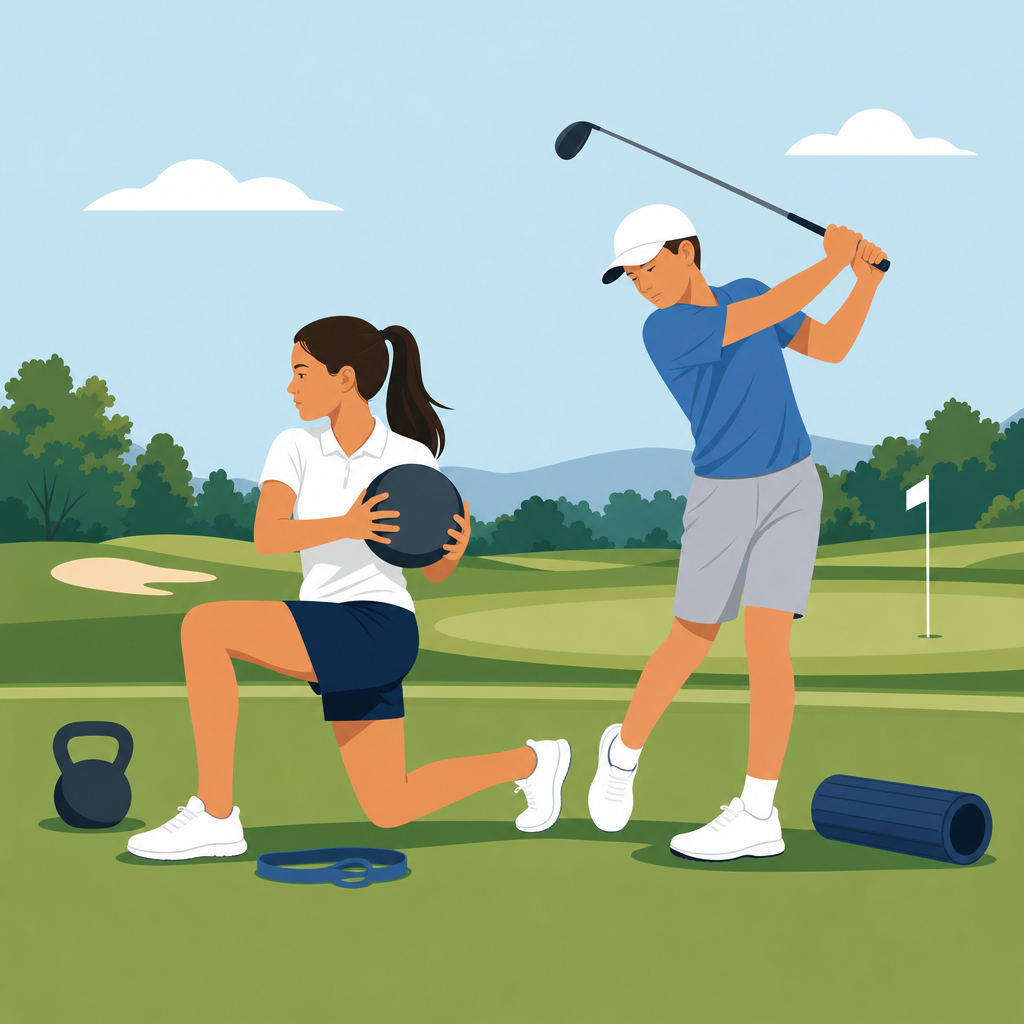
Golf strength and conditioning for junior athletes is not about bodybuilding, and it is not a side program separate from swing work. It is a structured training process that improves how a player moves, produces force, controls the club, and recovers between rounds. For serious juniors, especially those training full-time in Florida, it becomes a core part of player development because golf performance depends on mobility, stability, power, endurance, and injury prevention working together.
Parents often ask what strength and conditioning means in a golf academy setting. In practical terms, it is the physical preparation that supports better swing mechanics, more consistent ball striking, safer practice volume, and stronger tournament readiness. That includes movement screening, rotational power training, lower-body strength, scapular stability, anti-rotation core work, speed development, recovery planning, and age-appropriate workload management. When we build programs for junior golfers, we do not chase generic fitness. We train qualities that show up on the course.
This matters because junior golf has changed. College coaches now evaluate not only scores and tournament schedules, but also athletic potential, durability, and long-term upside. A player who can maintain posture late in a round, generate clubhead speed without losing control, and stay healthy through a dense tournament calendar has a measurable advantage. Florida adds another layer. Year-round warm-weather training allows juniors to blend on-course work, gym training, and recovery routines without the interruptions common in cold-weather states.
What Golf Strength and Conditioning Actually Includes
Golf-specific strength and conditioning develops the physical traits most closely tied to swing efficiency and tournament performance. The major categories are mobility, stability, strength, power, speed, and energy system support. Mobility refers to usable range of motion, especially through the hips, thoracic spine, shoulders, and ankles. Stability means controlling those joints under load and during rotation. Without both, juniors often compensate in the lumbar spine, lose sequencing, or struggle to repeat impact positions.
Strength is the athlete’s ability to produce force. In golf, that usually starts with the ground. Lower-body strength helps a player create pressure, transfer force efficiently, and maintain balance through the swing. Power is the ability to express that force quickly. Medicine ball rotational throws, jump variations, and resisted speed drills are common tools because they train explosive intent without overcomplicating mechanics. Speed training focuses on improving swing velocity while keeping movement quality intact.
Conditioning in golf is different from conditioning in soccer or tennis. Junior golfers do not need nonstop high-intensity running, but they do need work capacity. Tournament golf requires walking multiple rounds, carrying or managing equipment, handling heat, and sustaining concentration for four to five hours. A well-designed program supports postural endurance, lower-leg resilience, and recovery between practice sessions and competition days.
Why Junior Golfers Need a Different Approach Than Adults
Junior athletes are still developing physically, neurologically, and emotionally. That changes how a golf academy should program training. A 13-year-old with rapid growth, limited body awareness, and uneven mobility needs a different plan than a 17-year-old preparing for college golf. The principles stay the same, but exercise selection, volume, loading, and coaching cues must match the athlete’s training age and stage of maturation.
In younger juniors, the priority is movement literacy. We spend more time teaching hinge mechanics, landing positions, split-stance control, trunk stiffness, and shoulder positioning than loading heavy barbells. As athletes mature, we can progress to more advanced force production and speed work. That progression matters because early specialization without physical preparation often leads to overuse issues, especially in the low back, wrists, elbows, and shoulders.
Parents should also understand that growth spurts can temporarily disrupt coordination. A player who looked sharp six months ago may suddenly lose timing, posture, or balance. That is not always a swing problem. Often the athlete needs mobility work, deceleration training, and a short reset in strength programming while the body adapts. Good golf strength and conditioning accounts for those changes instead of forcing the same workload year-round.
The Physical Qualities That Most Affect Golf Performance
The most important physical quality for junior golfers is rotational power built on control. Golf is a sequencing sport. Force starts from the ground, transfers through the hips and trunk, and reaches the club through efficient timing. If a player lacks hip internal rotation, thoracic rotation, or lead-side stability, swing changes become harder to hold under pressure. That is why physical training and technical coaching should work together, not in separate silos.
Grip strength and forearm endurance also matter more than many families expect. They influence club control, face stability, and fatigue resistance late in rounds. Scapular strength supports shoulder health and helps juniors maintain posture through repeated swings. Single-leg strength improves balance and pressure management. Anti-rotation core training teaches the trunk to resist collapse so the athlete can create speed without losing shape.
| Physical quality | Why it matters in junior golf | Common training methods |
|---|---|---|
| Hip and thoracic mobility | Supports turn, sequencing, and cleaner impact positions | 90/90 variations, open-book drills, half-kneeling rotations |
| Lower-body strength | Improves force production, balance, and ground reaction use | Split squats, trap bar deadlifts, step-ups |
| Rotational power | Increases clubhead speed and transfer of energy | Medicine ball scoop tosses, shotput throws, jump-to-throw series |
| Scapular and shoulder stability | Protects the shoulder complex during high-volume practice | Rows, carries, band external rotation, push-up progressions |
| Core stiffness and anti-rotation | Helps maintain posture and control during high-speed rotation | Pallof presses, dead bugs, plank variations |
| Work capacity and recovery | Supports long rounds, tournament density, and heat tolerance | Sled pushes, tempo circuits, walking volume, bike intervals |
How a Full-Time Golf Academy Should Structure Training
In a full-time academy, strength and conditioning has to fit the rhythm of golf development. That means coordinating gym work with swing sessions, short game practice, on-course training, tournament travel, and academics. The goal is not to exhaust the athlete. The goal is to place the right stimulus on the right day. Heavy lower-body strength work before a speed session or tournament round usually creates unnecessary interference.
We typically organize training around weekly emphasis. Early in the week may include higher-intensity strength and power sessions when the player is freshest. Midweek may shift toward speed, mobility, and lower-volume maintenance. Tournament weeks often reduce load and increase activation, movement quality, and recovery. This is basic periodization. It keeps the athlete adapting without carrying fatigue into scoring environments.
Florida offers a practical advantage here. Because outdoor play is available year-round, juniors can train consistently instead of losing months to winter weather. That consistency improves the relationship between physical development and technical progress. Players can test new movement capacity on the range and on the course immediately. Over time, that creates better transfer than stop-start seasonal training.
Injury Prevention, Recovery, and Tournament Durability
Golf does not have the collision demands of football, but junior golfers still accumulate significant stress. Repeated swings, range volume, travel, uneven sleep, heat exposure, and growth-related changes can all raise injury risk. The most common concerns are low-back irritation, wrist pain, elbow overload, shoulder dysfunction, and general fatigue that reduces swing quality before an injury ever appears.
Injury prevention starts with load management. Coaches need to know how many balls a player is hitting, how often they are lifting, how much walking they are doing, and where tournament stress is building. Screening helps, but daily observation matters just as much. If a junior cannot rotate well, cannot control single-leg positions, or shows visible fatigue in warm-ups, training should adjust. Pushing through every session is not discipline. It is poor planning.
Recovery is a performance skill. Junior golfers need consistent sleep, hydration, basic nutrition habits, and post-session routines that lower stiffness. In Florida, hydration and electrolyte planning matter because heat and humidity increase fluid loss during long practice blocks and tournament rounds. Recovery also includes deload weeks, mobility resets, and time away from max-effort training when the competitive calendar gets dense.
How Strength and Conditioning Supports College Recruiting
Golf strength and conditioning helps recruiting because it improves the traits college coaches notice over time: distance potential, movement quality, consistency late in rounds, and the ability to handle a demanding schedule. Coaches recruiting for college golf are evaluating more than one tournament finish. They look for juniors who can continue developing once they enter a structured team environment with travel, school demands, and year-round performance expectations.
A well-conditioned player often presents a stronger overall profile. Better posture, cleaner movement, and visible athleticism support the impression that the athlete can tolerate higher practice loads and continue adding speed. That does not replace scoring. It supports scoring. For families building a recruiting timeline, physical development should be part of the long-term plan, just like tournament scheduling, video review, and communication with college programs.
For international families, this is especially important. Many talented players arrive with strong technical foundations but less experience in structured athletic development. Once they understand how American college programs value strength, mobility, and sports performance habits, their preparation becomes more complete. That transition is smoother in a boutique academy environment where coaches can individualize training and coordinate across golf, fitness, and academics.
What Parents and Athletes Should Look For in a Program
Not every golf fitness program is truly golf-specific. Parents should ask whether training starts with assessment, whether coaches communicate with golf instructors, and whether the plan changes during tournament weeks. You should also ask who supervises lifts, how progression is tracked, and whether the environment is built for juniors rather than adult general fitness. Those details determine whether strength work helps performance or simply adds fatigue.
The strongest programs are individualized. They account for age, movement quality, training history, injury history, tournament load, and current swing priorities. They also teach athletes why they are doing each exercise. That education matters. Juniors who understand the link between hip mobility, lead-leg stability, and ball striking usually buy into the process faster and train with better intent.
Golf strength and conditioning for junior athletes works best when it is integrated, progressive, and specific to the player in front of you. It should improve speed, posture, control, and durability without taking away from technical development or academics. In a Florida full-time academy setting, that integration is easier to deliver because year-round training, tournament access, and daily coach communication create a more complete development model.
If you are evaluating golf academies, look closely at how they connect sports performance training to on-course results, recovery, and college recruiting. The right program will not promise shortcuts. It will show you a clear process for building a stronger, healthier, more competitive junior golfer. Learn more about our RPS Golf Academy approach, request an academy tour, or speak with admissions about what full-time training looks like for your athlete.
Frequently Asked Questions
What does golf strength and conditioning actually mean for junior athletes?
Golf strength and conditioning for junior athletes is a structured training approach designed to improve the physical qualities that directly support performance on the course. It is not bodybuilding, and it is not just lifting weights to “get stronger.” For junior golfers, the goal is to build better movement patterns, improve mobility and stability, develop efficient power, increase endurance, and reduce the risk of injury. A well-designed program helps a player create speed without losing control, maintain posture throughout the swing, and recover more effectively between practice sessions, tournaments, and travel.
For serious junior players, strength and conditioning should work alongside technical coaching rather than sit off to the side as a separate activity. The golf swing places demands on the body that require coordination between the hips, core, shoulders, and lower body. If a junior athlete lacks thoracic mobility, hip rotation, single-leg stability, or core control, those limitations often show up in the swing as compensation patterns. Over time, those compensations can affect consistency, power production, and even lead to overuse issues. A proper training program addresses those underlying physical gaps so the athlete can make swing changes more effectively and repeat them under pressure.
At the junior level, this kind of training also supports long-term athletic development. That means helping young golfers move well first, then gradually layering in strength, speed, and capacity as they mature. The best programs are age-appropriate, progressive, and individualized. They teach juniors how to warm up properly, how to train with intent, and how to take care of their bodies through periods of heavy practice and competition. In that sense, golf strength and conditioning becomes a core part of player development, not an optional extra.
Is strength and conditioning safe for junior golfers, and at what age should it start?
Yes, strength and conditioning is safe for junior golfers when it is supervised appropriately and built around the athlete’s age, movement ability, and training experience. One of the biggest misconceptions is that young athletes should avoid structured physical training until they are older. In reality, juniors benefit greatly from learning how to move correctly, control their body, and build foundational strength early on. The key is that the training must match their stage of development. A younger player may focus more on coordination, balance, bodyweight strength, landing mechanics, and mobility, while an older or more physically mature junior can progress into more advanced strength and power work.
Starting does not mean placing a child into an adult lifting program. It means teaching sound movement skills in a progressive way. That can include squatting, hinging, pushing, pulling, rotating, resisting rotation, sprint mechanics, medicine ball work, and structured warm-up habits. As the athlete demonstrates control and consistency, load and complexity can increase gradually. This process is often safer than leaving a junior athlete unprepared for the repetitive physical demands of full-time golf practice, tournament play, range sessions, and travel.
For juniors training and competing seriously, especially in high-volume environments like Florida, not doing any physical preparation can create more problems than doing an intelligent program. Young players often practice for long hours in heat, hit large volumes of balls, and play on consecutive days. Without adequate strength, mobility, and recovery capacity, the body can begin to break down. A qualified coach will monitor workload, prioritize technique, and make sure training enhances development rather than adding unnecessary fatigue. Safety comes from smart coaching, clear progression, and individualization, not from avoiding training altogether.
How does strength and conditioning help junior golfers improve swing speed and distance without hurting accuracy?
Strength and conditioning helps junior golfers increase swing speed and distance by improving the physical abilities that create efficient force production. Distance is not just about swinging harder. It depends on how well an athlete can use the ground, sequence the body, transfer energy through the torso, and control the clubface through impact. A junior who improves lower-body strength, rotational power, core stiffness, and mobility often develops more speed because the body can generate force more effectively and deliver it more consistently.
Just as important, a good program does not chase speed at the expense of control. In golf, power and accuracy are connected through stability and movement quality. If a player adds force but cannot stabilize on one leg, maintain posture, or control rotation, the result may be more inconsistency rather than better performance. That is why quality programs train both the engine and the brakes. They develop power through exercises like medicine ball throws, jump variations, and strength work, while also reinforcing balance, deceleration, pelvic control, trunk stability, and joint positioning.
For junior athletes, this balanced approach matters even more because their bodies are still developing. The goal is not simply to make them stronger in the gym. The goal is to help them express speed in a way that supports the swing they are building with their coach. When physical training is aligned with technical development, players often find they can create speed more naturally, repeat their motion under pressure, and hold up better late in rounds and tournaments. Increased distance is valuable, but lasting gains usually come when the athlete is also more stable, more coordinated, and better able to recover from the demands of training.
What should a junior golf strength and conditioning program include?
A complete junior golf strength and conditioning program should include far more than a few general gym exercises. It needs to address the full set of physical qualities that influence golf performance: mobility, stability, strength, power, endurance, coordination, and recovery. Most effective programs begin with movement assessment to identify restrictions, asymmetries, and control issues that may be limiting the swing or increasing stress on certain joints. From there, the program can be tailored to the player’s age, training history, tournament schedule, and technical goals.
Mobility work is typically included to improve areas that are essential for the swing, such as the hips, thoracic spine, shoulders, and ankles. Stability and motor control training help the athlete maintain position and sequence movement more effectively, especially through the pelvis, trunk, and single-leg patterns that are so important in golf. Strength training builds the capacity to produce and absorb force, while power training teaches the player to apply that force quickly. For many junior golfers, this includes medicine ball rotational work, lower-body explosive exercises, and progressive resistance training performed with strong technical standards.
The program should also include conditioning that matches the demands of the sport. Golf requires repeated high-quality efforts across long practice days and multi-round tournaments, often in challenging weather. That means juniors need aerobic capacity, muscular endurance, and recovery ability, not just short bursts of effort. Warm-up routines, cooldown strategies, and recovery practices such as hydration, sleep, and training load management are also part of the picture. When done properly, all of these elements support the same outcome: a junior athlete who moves better, swings more efficiently, stays healthier, and can handle the workload required for serious improvement.
Why is strength and conditioning especially important for serious junior golfers training full-time in Florida?
For serious junior golfers training full-time in Florida, strength and conditioning becomes especially important because the overall load on the athlete is often much higher than many people realize. These players may be combining lessons, range sessions, on-course practice, tournament rounds, school responsibilities, travel, and year-round competition in a hot and physically demanding environment. That combination places stress on the body and nervous system even if golf does not look as physically intense as other sports from the outside. Without a structured physical plan, juniors can struggle with fatigue, inconsistent performance, slower recovery, and overuse issues.
Florida’s climate adds another layer of challenge. Heat, humidity, and frequent outdoor training increase the demand for hydration, recovery, and physical resilience. A junior athlete who lacks general fitness and recovery capacity may not just feel tired; they may lose focus, posture, and swing quality late in practice or during the final holes of a tournament. Strength and conditioning helps build the foundation needed to handle that environment. It improves work capacity, supports better recovery between rounds, and helps the athlete maintain physical and technical consistency across longer training blocks.
Full-time junior development also tends to magnify whatever physical weaknesses a player has. If there is limited hip mobility, poor trunk control, or low strength relative to the training load, those issues show up repeatedly because the athlete is practicing so often. Over time, small limitations can become performance barriers. A structured strength and conditioning program helps close those gaps before they become bigger problems. It gives the junior golfer a more durable body, a better platform for swing development, and a more professional approach to long-term progress. For committed players, especially those training at a high level in Florida, it is not an optional add-on. It is part of what allows them to train, compete, and develop at the level they are aiming for.