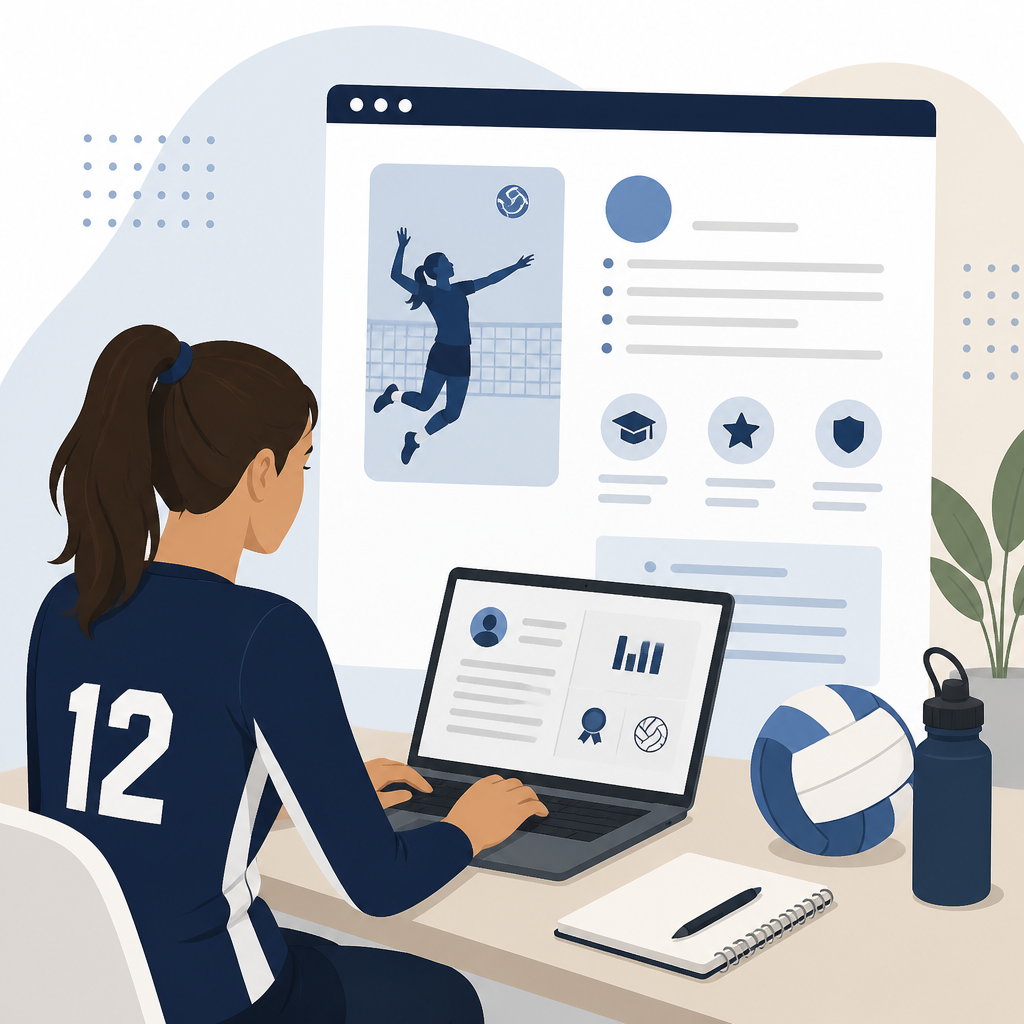
A volleyball recruiting profile is the core document, video set, and contact record that college coaches use to evaluate whether a junior athlete fits their roster, level, and scholarship budget. For families navigating the recruiting process, it often feels like a simple bio page. In practice, it is a structured presentation of athletic performance, academic readiness, position-specific traits, and communication habits. When we help athletes build profiles, we treat the profile as a living recruiting tool, not a one-time form.
The term volleyball recruiting profile usually refers to a digital profile hosted on a recruiting platform, club website, academy page, or personal athlete site. It includes measurable data, tournament schedule, academic information, highlight video, and direct contact details. Coaches rely on it because they cannot attend every event, and they need fast comparisons between prospects. A weak profile creates uncertainty. A strong profile answers questions before a coach has to ask them.
This matters because volleyball recruiting moves quickly and often starts earlier than families expect. By freshman and sophomore year, many athletes already need match footage, academic records, and a consistent introduction message. For international families and players relocating for full-time academy training in Florida, the profile also becomes a translation tool. It explains club level, competition history, and academic pathway in a format U.S. college coaches understand.
A complete profile does not guarantee recruitment, and it should never be framed that way. What it does is improve clarity. Coaches can assess height, reach, movement quality, positional fit, and competitive level more efficiently. Parents can track the recruiting timeline with less guesswork. Athletes can present themselves professionally instead of sending scattered clips and incomplete stats. That structure is especially valuable in volleyball, where role specialization and system fit matter as much as raw talent.
At a boutique academy, we see the same pattern every year. Athletes work hard in training, compete well at showcases, and still miss opportunities because their profiles are outdated or vague. A college staff may like a libero’s defensive instincts or an opposite hitter’s arm speed, but if the profile lacks verified measurements, recent video, or a tournament schedule, the evaluation stalls. Building the profile correctly is one of the highest-return tasks in the recruiting process.
What college coaches want to see first
College coaches are looking for efficient proof. They want to know who the athlete is, what position she plays, how she moves, what level she competes at, and whether academic eligibility is realistic. The first screen is rarely emotional. It is practical. If a profile makes basic information hard to find, coaches often move on to the next athlete.
Start with the athlete’s full name, graduation year, primary and secondary positions, dominant hand, height, approach touch, block touch, standing reach, club team, high school team if relevant, and contact information for both athlete and parent. Include coach contact details as well. For volleyball specifically, coaches want position context. A 5-foot-8 setter, a 6-foot middle, and a libero will be evaluated through different lenses. Put the position up front.
Academics belong near the top, not buried at the bottom. Include GPA, test scores if available and useful, intended major if known, and school type. This helps coaches judge admissions fit early. If you are an international student, clarify grading scale and expected graduation equivalent. We have found that simple academic clarity prevents unnecessary back-and-forth and keeps more conversations moving.
Video also ranks near the top of priorities. Coaches typically prefer a short highlight video first, followed by uncut game footage. The highlight reel should show the athlete’s role-specific actions clearly. For an outside hitter, that means passing, attacking in and out of system, blocking, transition movement, and serve receive. For a setter, it means location, tempo, decision-making, defense, and movement to target. Coaches are evaluating transferable match skills, not flashy editing.
The essential sections of a volleyball recruiting profile
A strong profile is organized so a coach can scan it in less than two minutes. Every section should answer a specific recruiting question. Personal details answer identity and logistics. Measurables answer physical projection. Video answers skill translation. Competition history answers level. Academics answer eligibility and admissions fit. Communication history answers seriousness and maturity.
Include an athlete summary written in plain language. Keep it factual. Example: “Class of 2028 outside hitter with six-rotation experience, strong serve receive background, and year-round training in Florida against national-level club competition.” That sentence gives a coach immediate context. Avoid exaggerated claims such as “unstoppable hitter” or “elite leader.” Let the footage and competition record support the case.
Tournament schedule is one of the most overlooked sections. Coaches need to know where they can evaluate the athlete live. List event name, dates, city, team name, jersey number, and court assignment when available. Update this regularly during club season. If there is no current schedule, a coach may assume the profile is inactive.
Statistics can help, but only when they are credible and relevant. Volleyball is not recruited purely from box scores. Hitting percentage, aces, assists, digs, and blocks provide context, but they do not replace film. Use stats from recognized competition and identify the source. Coaches know that team systems affect individual numbers.
| Profile Section | What to Include | Why Coaches Care |
|---|---|---|
| Header | Name, graduation year, positions, height, handedness, contacts | Confirms basic fit immediately |
| Measurables | Standing reach, block touch, approach touch, verified dates | Shows physical projection by position |
| Academics | GPA, test scores, school type, intended major | Helps assess eligibility and admissions range |
| Video | Highlight reel plus full match footage links | Validates skill transfer under pressure |
| Competition | Club, high school, tournament schedule, awards | Places performance in level context |
How to build better video and measurables
Video quality matters, but clarity matters more. Use a stable, elevated angle whenever possible. Label the athlete before each rally or use simple spot-shadowing at the start of the clip. Do not overuse effects, music, or slow motion. Coaches want to see reading, timing, platform control, arm swing, footwork, and decision-making at normal speed.
Position-specific sequencing makes a difference. A libero’s video should lead with serve receive and live defense, then emergency plays, short-ball reads, and out-of-system setting if that is part of the role. A middle blocker should show first-step movement, closing on blocks, transition to attack, and range laterally. A setter should include front-row and back-row setting, tempo variation, defensive work, and communication presence.
Measurables should be recent and credible. If you report approach touch, block touch, and standing reach, note when they were tested and who recorded them. We recommend updating them at least twice each year, especially during growth periods. College staffs compare current body size and jump data against positional benchmarks and roster needs. Stale numbers create doubt.
Do not hide limitations. If an athlete is undersized for a position, use the profile to highlight compensating strengths such as first-contact quality, volleyball IQ, terminal serving, lateral speed, or multi-position value. Coaches recruit skill packages, not only raw height. At the same time, families should stay realistic about level fit. Honest positioning creates better college matches than sending the same profile to every program on a ranking list.
Matching the profile to the recruiting timeline
The right profile changes by grade level. Freshmen should focus on clean fundamentals: accurate measurables, academic habits, good introductory video, and competition schedule. Sophomores should add stronger match footage, updated testing, and more intentional outreach. Juniors need the most polished version because this is often the evaluation window when serious recruiting conversations accelerate. Seniors may still need updates, especially if they are late bloomers, transfers, or international athletes entering the U.S. process.
Communication should match the profile stage. Early messages can be brief and informational. Later emails should reference fit, upcoming events, academic interest, and recent film. Every email should link directly to the profile and latest video. Do not make a coach search for information. The easier you make evaluation, the more likely the coach will keep engaging.
For athletes training full-time in Florida, the profile should emphasize year-round competition access and event density. College coaches know Florida club volleyball offers frequent exposure opportunities and strong competition windows. If an athlete relocated from a cold-weather state for more consistent development, that context is worth stating. It signals commitment and explains recent improvement trends in movement, jump capacity, and game speed.
International athletes should also explain recruiting equivalents clearly. List national team experience, federation competition, or school structure in terms U.S. coaches recognize. If English is a second language, the profile should still be concise and polished. Ask a coach, admissions advisor, or recruiting mentor to review wording before sending it broadly.
Common mistakes that weaken a profile
The biggest mistake is treating the profile like a scrapbook instead of a decision tool. Long personal essays, excessive graphics, and outdated awards distract from what matters. Coaches need current evidence. Another common problem is inconsistency. The video says outside hitter, the bio says opposite, and the club roster lists defensive specialist. That creates uncertainty about role and projection.
Families also wait too long to update information. Graduation year, jersey number, contact details, coach information, and tournament schedule change often. Review the profile monthly during the club season. We also see athletes rely too heavily on one dramatic highlight clip. A coach may enjoy the clip, but still need to know whether the athlete passes well, reads the game, competes consistently, and fits a system.
Finally, many profiles fail because the outreach behind them is weak. A strong page cannot replace direct communication. The athlete should send clear emails, respond promptly, and follow up after events with updated film. Parents can support organization, but coaches want to see that the athlete can communicate responsibly.
A well-built volleyball recruiting profile makes evaluation easier, presents the athlete professionally, and keeps recruiting conversations moving. It should show measurable traits, role-specific video, academic readiness, competition level, and an updated event schedule. Just as important, it should reflect honest fit. The right goal is not maximum volume. The goal is to connect with programs where the athlete can contribute, develop, and succeed academically.
If you are building or revising a profile, start with the essentials: current measurables, clear position labeling, recent highlight video, full match footage, academics, and tournament schedule. Then review every section through a coach’s eyes. Could someone understand this athlete in two minutes? If not, simplify and sharpen it.
Families who want more structure should use this page as the starting hub for every part of volleyball recruiting: video strategy, email outreach, showcase preparation, scholarship planning, boarding academy life, and year-round player development in Florida. Learn more about our volleyball academy admissions process or request guidance on building a recruiting profile that reflects how you actually compete.
Frequently Asked Questions
What should be included in a strong volleyball recruiting profile?
A strong volleyball recruiting profile should give college coaches a clear, fast, and accurate snapshot of who the athlete is as a player, student, and potential fit for a program. At minimum, it should include the athlete’s full name, graduation year, primary and secondary positions, height, dominant hand, club team, high school team, jersey number, contact information, and coach contact details. Coaches also expect to see key measurables such as approach jump, block jump, standing reach, and any verified speed or agility data if relevant. These details help them quickly assess whether an athlete fits the physical and positional standards of their level.
Beyond the basics, the profile should include academic information such as GPA, test scores if available, intended major or academic interests, and core course strength. Coaches recruit students, not just athletes, so academic readiness matters. A polished profile also includes a skills or highlight video, a competition schedule, recent tournament results, and links to full-match film when possible. It is helpful to present position-specific strengths clearly, such as serve receive consistency for defensive specialists, blocking range for middles, set tempo and decision-making for setters, or terminal attacking ability for pin hitters. The best profiles are organized, current, and easy to scan, allowing a coach to understand the athlete’s potential in just a few minutes.
How important is highlight video in a volleyball recruiting profile?
Highlight video is one of the most important parts of a volleyball recruiting profile because it often determines whether a coach takes the next step. Coaches may receive hundreds or even thousands of athlete inquiries, and video helps them quickly evaluate movement quality, athleticism, technique, and position-specific effectiveness. A written profile can say an athlete is a strong outside hitter or a fast setter, but video provides proof. It shows how the athlete performs in real match situations, how they move between contacts, and whether their skills translate against live competition.
The most effective volleyball recruiting videos are short, well-labeled, and built with the coach’s perspective in mind. A strong highlight reel usually starts with the athlete’s name, graduation year, position, jersey number, and key measurables, followed by clips that identify the athlete before each rally. Coaches should not have to guess who to watch. For hitters, include a range of attacks, serve receive, blocking, transition play, and defense if relevant. For setters, show location, tempo, decision-making, movement to the ball, and defensive effort. For liberos and defensive specialists, include serve receive, platform control, reading ability, pursuit, and out-of-system contacts. It is also smart to include full-set or full-match footage in addition to highlights, because coaches want to see consistency, court awareness, and response to pressure, not just best-case moments.
How often should a volleyball recruiting profile be updated?
A volleyball recruiting profile should be updated regularly because recruiting decisions are made from current information, not outdated snapshots. This is why many experienced families treat the profile as a living recruiting document rather than a one-time project. At a minimum, athletes should update the profile whenever there is a meaningful change in measurables, academic performance, club or school team placement, contact information, tournament schedule, or video content. If an athlete improves their approach jump, earns a stronger GPA, changes clubs, adds new match film, or attends a major showcase, those changes should appear promptly in the profile.
Frequent updates also signal seriousness and professionalism. Coaches notice when a profile is active and current because it suggests the athlete understands the recruiting process and communicates well. During club season, many athletes benefit from reviewing and refreshing their profile every few weeks. That can include adding recent highlights, posting upcoming event schedules, listing court numbers when available, and making sure coach contact information is accurate. Even small updates matter if they make it easier for a college coach to evaluate and follow the athlete. A profile that stays current creates momentum, while an outdated profile can cause missed opportunities or make a coach question whether the athlete is still actively pursuing recruiting.
What mistakes do athletes and families make when creating a volleyball recruiting profile?
One of the most common mistakes is treating the recruiting profile like a simple social bio instead of a decision-making tool for college coaches. Profiles often fail because they are too vague, too incomplete, or too hard to review quickly. Missing measurables, no academic information, outdated contact details, and poor-quality video are all common issues. Another major mistake is making coaches work too hard. If a coach cannot easily find the athlete’s position, graduation year, event schedule, or video links, they may move on to the next prospect. Clarity and convenience matter more than flashy design.
Families also sometimes overemphasize branding and underemphasize substance. An attractive profile cannot replace verified performance data, strong film, and consistent communication. Another mistake is including only dramatic highlight clips without enough context or position-specific value. Coaches want to see whether the athlete can help their roster, not just whether they had a few exciting plays. It is also a mistake to ignore academics, fail to personalize outreach, or let the profile sit unchanged for months. The strongest recruiting profiles are honest, complete, easy to navigate, and updated as the athlete develops. They present the athlete professionally without exaggeration and make it simple for a coach to say, “This player is worth tracking.”
Can a good volleyball recruiting profile help an athlete get noticed by college coaches?
Yes, a strong volleyball recruiting profile can absolutely improve an athlete’s chances of getting noticed, but it works best as part of a larger recruiting strategy. The profile itself is not magic. It does not replace skill development, competition level, academic readiness, or fit within a program’s recruiting needs. What it does is remove friction. When a coach hears about an athlete, receives an email, sees them at a tournament, or gets a recommendation from a club director, the profile becomes the central place where they can quickly evaluate whether the athlete deserves more attention. In that way, it is often the difference between being overlooked and moving into a coach’s active recruiting pool.
A good profile helps because it brings together the three things coaches care about most: performance evidence, academic viability, and communication reliability. It tells a complete story in a format that supports fast evaluation. If a coach can immediately see the athlete’s position, measurables, GPA, schedule, and video, they are much more likely to continue the conversation. It also helps athletes present themselves consistently across emails, recruiting platforms, and direct outreach. For many families, this is where recruiting starts to feel more manageable. Instead of scrambling to explain everything each time they contact a coach, they can direct coaches to a profile that is organized, current, and credible. That kind of preparation does not guarantee offers, but it gives the athlete a far better chance to be evaluated fairly and remembered for the right reasons.