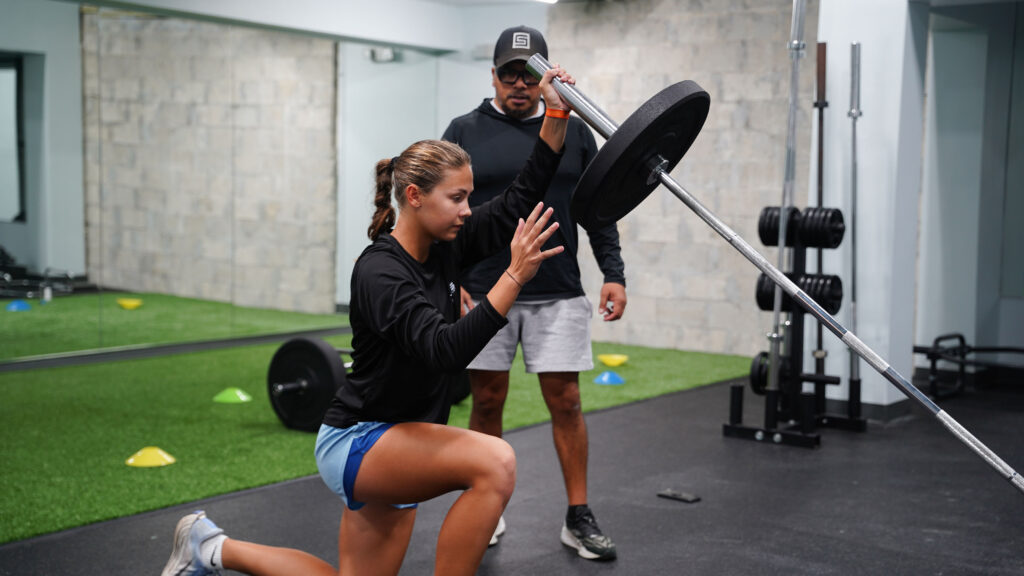
Strength training can be one of the best things a teen athlete ever does—or one of the fastest ways to get frustrated or hurt. The difference isn’t age. It’s coaching, technique, progression, and recovery.
When done the right way, strength training helps teen athletes:
- run faster and jump higher
- improve balance and body control
- reduce injury risk (especially knees, ankles, shoulders)
- build confidence that carries into competition
When done the wrong way—ego lifting, sloppy reps, no plan—it can create nagging pain, stalled progress, and bad habits that take months to undo.
Want a coach to assess form, build a safe plan, and match training to your sport and schedule? Contact RPS Academies
Is strength training safe for teens?
Yes—for most teens, properly coached strength training is safe and beneficial. The biggest risk usually isn’t the weight itself; it’s poor technique, rushing progress, and training like an adult bodybuilder instead of an athlete.
A smart teen program prioritizes:
- movement quality (how you squat, hinge, push, pull, and brace)
- gradual progression (small jumps, steady consistency)
- balanced development (hips/back/core, not just arms/chest)
- recovery (sleep, nutrition, and spacing hard sessions)
If those pieces are in place, strength training becomes a performance advantage.
What “good” teen strength training looks like
Teen athletes don’t need complicated workouts. They need a program that builds:
- strong movement patterns
- joint stability
- power and speed support
- durability across a long season
The simplest way to think about it is:
Train movements, not muscles.
Sports are made of squatting, hinging, pushing, pulling, rotating, sprinting, and landing. Your program should improve those patterns.
The 5 pillars of strength training for teen athletes
1) Technique first, always
Before adding load, athletes should be able to perform clean reps with:
- stable posture (no collapsing or twisting)
- controlled tempo
- full, pain-free range of motion
- consistent bracing (core engaged)
A great rule: if you can’t control it slow, you can’t own it fast.
2) Build the “engine room”: hips, hamstrings, and core
Many teen athletes are quad-dominant from sports. Strong hips and hamstrings support:
- acceleration and top-end speed
- knee health and landing control
- back resilience
- stronger change of direction
This is why great programs include hinges, single-leg work, and posterior-chain training every week.
3) Progress slowly—but never randomly
The fastest way to get stronger is consistency with a plan:
- repeat key movements weekly
- track sets/reps/loads
- make small progressions
- deload or reduce volume when needed
Random workouts feel hard, but planned training gets results.
4) Train both sides (single-leg and unilateral work)
Sport is rarely symmetrical. Single-leg strength improves:
- balance and control
- cutting ability
- knee tracking
- hip stability
Expect to see split squats, lunges, step-ups, single-arm rows and presses.
5) Recovery is part of the program
Teens grow, practice, travel, and study—recovery gets squeezed. But strength gains are built during recovery, not during the set.
Baseline recovery priorities:
- sleep consistency (as close to 8–10 hours as possible)
- hydration daily
- protein at each meal
- 48 hours between hard lower-body sessions when possible
The movement menu every teen athlete should train
A complete program includes these categories:
Squat pattern
Examples: goblet squat, front squat, split squat
Purpose: leg strength, posture, joint control
Hinge pattern
Examples: Romanian deadlift, kettlebell deadlift, trap bar deadlift
Purpose: hips/hamstrings, power foundation, back resilience
Push pattern
Examples: push-ups, dumbbell bench, overhead press variations
Purpose: upper-body strength and shoulder stability
Pull pattern
Examples: rows, assisted pull-ups, band pull-aparts
Purpose: posture, shoulder health, pulling power
Core/bracing
Examples: dead bug, plank variations, carries, Pallof press
Purpose: force transfer and injury resistance
Athletic power (light and fast)
Examples: med ball throws, jump variations, sled pushes
Purpose: convert strength into sport output
(Power work should be coached and kept crisp—not exhausting.)
The safest way to start: progression ladders
Teens shouldn’t jump straight to heavy barbells just because they’re in a weight room. Use progression ladders that build mastery.
Squat ladder
Bodyweight squat → goblet squat → split squat → front squat (later)
Hinge ladder
Hip hinge drill → kettlebell deadlift → RDL → trap bar deadlift (often the best first heavy option)
Push ladder
Incline push-up → push-up → dumbbell press → barbell bench (later)
Pull ladder
Band row → dumbbell row → assisted pull-up → pull-up
This approach makes strength sustainable and repeatable.
A simple 3-day strength plan for teen athletes
This is a practical template for most teen athletes in the off-season. Keep the loads moderate and focus on perfect reps.
Day 1: Lower body + core (strength focus)
- Goblet squat — 3×8
- RDL (dumbbells/kettlebells) — 3×8
- Reverse lunge — 3×8 each side
- Calf raises — 2×12–15
- Dead bug — 3×8 each side
Day 2: Upper body + core (balance and posture)
- Push-ups (or dumbbell bench) — 3×8–12
- 1-arm dumbbell row — 3×10 each side
- Half-kneeling overhead press — 3×8 each side
- Face pulls or band pull-aparts — 2×12–15
- Side plank — 2×20–40 seconds each side
Day 3: Full body + power (light and fast)
- Trap bar deadlift (moderate, clean reps) — 4×5
- Split squat — 3×8 each side
- Med ball throws (or vertical jumps if coached) — 4×5
- Farmer carries — 3×30–45 seconds
- Pallof press — 2×10 each side
Quality control: stop a set when technique breaks down. Train to improve, not to survive.
How to progress (without getting hurt)
Progress should be boring—and that’s a good thing.
Option A: Add reps, then load
- Stay at the same weight until you hit the top of the rep range with perfect form
- Increase weight slightly, drop reps back down, repeat
Option B: Add sets over time
- Start at 2 sets for new movements
- Build to 3–4 sets over a few weeks
- Only then increase load
Option C: Progress control before weight
- Add a 2–3 second lowering phase
- Pause at the bottom
- Improve stability and range
This builds strength safely, especially during growth spurts.
In-season vs. off-season training
Off-season goal: build
- 2–4 days/week depending on sport load
- increase volume gradually
- emphasize strength and power development
In-season goal: maintain and protect
- 1–2 days/week is often enough
- reduce volume (fewer sets)
- keep intensity moderate
- prioritize hips, hamstrings, upper back, and core
- avoid soreness that hurts practice performance
If games are frequent, the program must support performance—not compete with it.
Common mistakes teen athletes make (and how to fix them)
Mistake 1: Chasing max lifts
Fix: focus on clean sets in the 6–12 rep range, plus athletic power work done fast and controlled.
Mistake 2: Skipping warm-ups
Fix: 5 minutes of mobility + activation + 2 ramp-up sets before working sets.
Mistake 3: Too much “mirror work”
Fix: build the back, hips, and core. Athletes need posture and stability more than extra curls.
Mistake 4: Training to failure constantly
Fix: keep 1–2 good reps in the tank most of the time. Consistency beats burnout.
Mistake 5: No plan, no tracking
Fix: track workouts. If you can’t measure it, you can’t improve it.
Parent notes: how to support safe progress
- Choose coaching and technique over “how much did you lift?”
- Encourage consistency and sleep, not only intensity
- Remember growth spurts can temporarily reduce coordination—reduce load, improve control, then build again
- Pain is a signal, not a badge. Persistent pain should be evaluated by a qualified professional.
Repurpose asset: Beginner Teen Strength Plan (download-ready)
This article can be turned into a one-page printable with:
- the 3-day template
- a warm-up checklist
- progression rules (add reps → add load)
- a tracking sheet for weights/reps
- “coach notes” boxes for technique cues
This is perfect for families who want structure without overwhelm.
Next step: build strength that actually transfers to sport
The best strength program is the one that matches the athlete’s sport, body, schedule, and goals—and evolves as they grow.
If you want a coach-led plan with form coaching, progressive programming, and athlete-specific adjustments: Contact RPS Academies
Frequently Asked Questions About “Strength Training for Teens: Building Power the Right Way”
1) At what age can teens start strength training safely?
Most teens can begin structured strength training once they can follow directions, demonstrate basic coordination, and perform bodyweight movements with control. Age matters less than readiness. A safe starting point is mastering patterns like squats, hinges, push-ups, rows, and bracing drills before adding heavier loads. Early training should emphasize technique, posture, and consistency rather than max weight. As skill improves, resistance can increase gradually. The goal is building a foundation for athletic performance and durability, not chasing numbers. When coached properly, starting earlier can improve movement quality and reduce injury risk over time.
2) Should teen athletes lift heavy weights to get stronger?
Teens don’t need constant heavy lifting to build meaningful strength. Most progress comes from consistent training in moderate rep ranges with excellent technique, controlled tempo, and gradual increases over time. Heavy weights can be appropriate later for some athletes, but only after they show stable movement, good bracing, and consistent form under fatigue. For many teen athletes, building strength through goblet squats, split squats, RDLs, rows, and presses creates strong results with less risk. Power is built by combining strength with speed-focused movements like throws or jumps—kept crisp, not exhausting.
3) How many days per week should a teen strength train during the season?
During a sport season, most teen athletes do best with one to two strength sessions per week. The purpose shifts from “build muscle” to “maintain strength, support joints, and stay resilient.” Sessions should be shorter, with fewer sets, and focused on high-value movements: hips/hamstrings, single-leg stability, upper-back strength, and core bracing. Loads should feel challenging but not create soreness that hurts practices or games. If the schedule is intense, it’s okay to reduce volume further—consistency is still the priority. A smart in-season plan keeps athletes strong without draining performance.
4) What are the most important exercises for teen athletes?
The best exercises are the ones that build sport-ready movement patterns: squats and split squats for leg strength and control; hinge variations like RDLs or trap bar deadlifts for hips and hamstrings; rows and pull-ups (or assisted pull-ups) for posture and shoulder health; pushes like push-ups or dumbbell presses for upper-body strength; and bracing work such as dead bugs, side planks, and carries for core stability. These movements transfer to sprinting, jumping, cutting, and contact better than isolations. A balanced program also includes mobility and landing mechanics to protect joints as intensity rises.
5) How can we prevent injuries while strength training as teens grow?
Injury prevention starts with technique, progression, and recovery. Teens should prioritize clean reps, stable posture, and controlled landings before increasing weight or complexity. Progress should be gradual—small load jumps, steady reps, and occasional lighter weeks. Warm-ups matter: prepare hips, ankles, and shoulders, then ramp into working sets. Recovery is essential during growth spurts, when coordination can temporarily dip. Sleep, hydration, and nutrition support adaptation and joint health. Pain that persists or changes movement should be addressed early by a qualified professional. The safest programs train the “engine and brakes”—strength and control together.