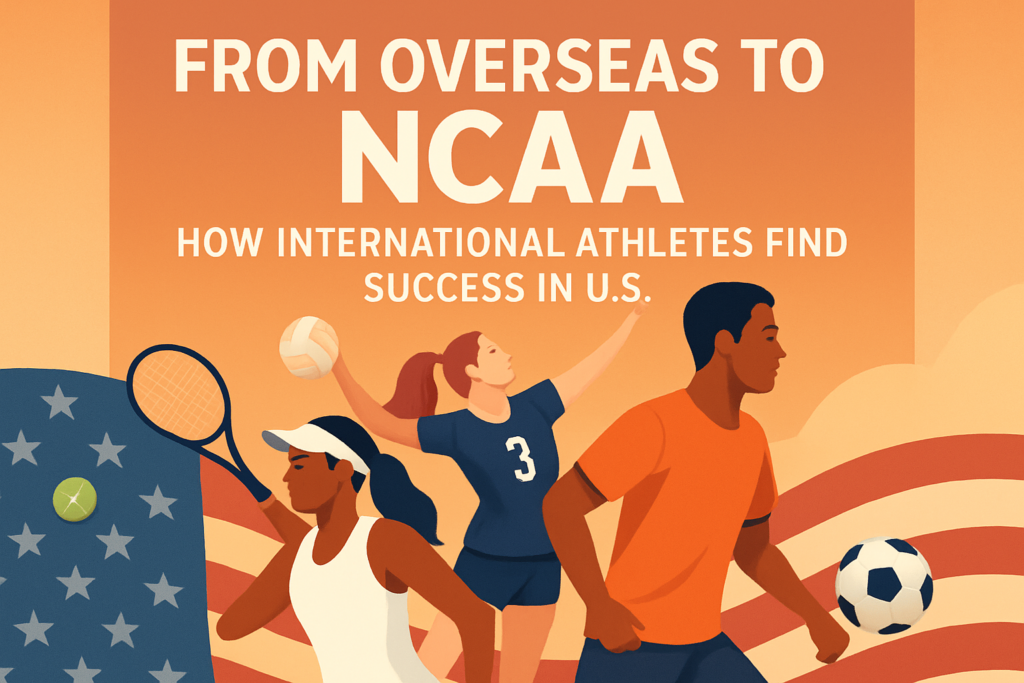
For many international families, the U.S. is appealing because it offers something rare: a pathway where sport and education can work together. But the journey from overseas competition to an NCAA (or other U.S. college) roster isn’t automatic. It’s a process that rewards planning, academic readiness, clear communication, and a strong transition strategy.
This guide breaks down international athlete recruitment in a way that’s practical and reassuring. You’ll learn what coaches evaluate, how to build a recruiting profile from abroad, how to avoid common mistakes, and how to prepare your student-athlete for success academically, socially, and athletically.
Want help mapping a recruiting and preparation plan for your family’s timeline and sport?
Contact RPS Academies
Step 1: Understand the U.S. college sports landscape (and what “NCAA” really means)
Many families use “NCAA” as a catch-all phrase, but U.S. college sports includes multiple pathways:
- NCAA (Divisions I, II, and III)
- NAIA
- Junior college (JUCO)
- Other college conference systems depending on sport
The best path depends on:
- the athlete’s current level and trajectory
- academic goals and readiness
- budget and financial aid possibilities
- how quickly the athlete needs playing time and development
A common international mistake is aiming only at the “biggest name.” A better approach is finding the best fit where the athlete can:
- play
- develop
- succeed academically
- thrive culturally
Step 2: Know what college coaches look for in international recruits
Coaches recruit international athletes for the same reasons they recruit domestic athletes: they want impact, reliability, and development potential. International recruits stand out when they reduce uncertainty.
Coaches typically evaluate:
Performance proof
- quality film or match footage
- results against credible competition
- consistency (not only best moments)
- role clarity (what you do well repeatedly)
Athletic traits
- speed, strength, power (depending on sport)
- movement efficiency and durability
- repeatability under fatigue
Coachability and competitiveness
- response after mistakes
- composure under pressure
- willingness to learn and adapt
Academic readiness
- ability to handle coursework in English
- study habits and time management
- stable grades or transcripts that show responsibility
Cultural readiness
- maturity and independence
- ability to live away from home
- communication style and professionalism
Your goal is to present evidence in each category so the coach doesn’t have to guess.
Step 3: Build a recruiting profile that works from anywhere in the world
International families sometimes overcomplicate this. You don’t need a perfect website. You need a clean, coach-friendly profile.
Your athlete profile should include:
- full name, graduation year, and citizenship
- sport, position/event, height/weight (if relevant)
- academics snapshot (current school, grades, course rigor)
- primary competition history and results
- coach contact (club/national coach if available)
- highlight video link + longer footage link
- upcoming competition schedule (even if it’s overseas)
- contact info for athlete and parent/guardian
If a coach can’t understand who your athlete is in 20 seconds, you will lose attention.
Step 4: Film: what international athletes should do differently
International film is often strong in skill but weak in clarity.
Make your film coach-friendly:
- put your jersey number and name at the start
- show 2–3 best clips immediately
- include sequences, not just highlights (coaches want context)
- show effort away from the ball (or between points)
- include full match/game options (even if unedited)
A strong highlight video is usually 2–4 minutes. The most important part is not editing style—it’s whether the film shows repeatable strengths that translate.
Step 5: Communication: how international athletes should contact coaches
International families sometimes worry about “bothering” coaches. In U.S. recruiting culture, proactive outreach is normal.
A strong first message includes:
- who you are (grad year, sport, position/event)
- what you do best (2–3 strengths)
- film link
- competition schedule and where the coach can watch
- one sentence on why the program fits (academics + sport)
- a simple next step request (call, evaluation, questions)
Communication should be:
- short
- respectful
- consistent
- athlete-led (parents can support, but the athlete should be the voice)
Follow-up matters. Coaches may not respond immediately, but consistent professional updates after meaningful events often open doors.
Step 6: Academics and language: the hidden success factor
Many international athletes can earn roster interest but struggle with academics if preparation is weak. The best international outcomes come from treating academics as part of recruiting—not something to “figure out later.”
Key preparation areas:
- English comfort (especially academic writing and comprehension)
- study routine consistency
- time management habits
- willingness to ask for help early
Practical family move:
Build academic readiness in parallel with sport development. It protects eligibility and reduces stress during transition.
Step 7: Cultural transition: preparing the athlete to thrive, not just arrive
The transition is often harder than families expect because it hits multiple layers at once:
- new country and routines
- new coaching style and expectations
- new academic system and language demands
- new social environment
- homesickness and identity stress
International athletes thrive when they have:
- a predictable daily routine
- community support and mentorship
- clear expectations
- healthy communication with home (not constant pressure)
A helpful mindset for families:
The first 6–12 weeks are an adaptation phase. Don’t judge the whole experience based on week one.
Step 8: Timeline planning: when to start the process
International recruiting works best when it’s planned backward from your target enrollment year.
A practical timeline approach:
- Year 1: build foundations (film, profile, English comfort, training consistency)
- Year 2: outreach and evaluation (emails, calls, fit-based targeting, stronger proof)
- Year 3: decisions and transition planning (academics, logistics, culture readiness)
Not every athlete has three years. If your timeline is shorter, the process becomes more focused:
- fewer target schools
- faster organization
- clear fit strategy
- stronger support around academics and adaptation
Common mistakes international families make (and how to avoid them)
Mistake: Chasing only the highest-profile schools
Fix: Target fit-based programs where the athlete can play and develop.
Mistake: Sending film without context
Fix: Provide a clear profile, role, and schedule. Coaches need clarity.
Mistake: Letting parents do all outreach
Fix: Athlete-led communication is a maturity signal.
Mistake: Ignoring academics until late
Fix: Build language and study habits early. It’s part of success.
Mistake: Underestimating transition stress
Fix: Plan routine, mentorship, and support. Adaptation is normal.
How a Florida-based academy environment can help international families
Many international athletes benefit from an environment that supports:
- consistent performance training and progression
- academic routine building and English immersion
- coaching feedback habits and professionalism
- cultural integration through community and structure
- recruiting organization and schedule planning
For overseas families, structure reduces uncertainty. A system that builds habits daily can make the U.S. pathway feel less risky and more predictable.
If you want to talk through whether this type of environment fits your athlete’s path, reach out.
Contact RPS Academies
Repurpose asset: “International Student-Athlete Handbook” outline
This article can be repurposed into a downloadable handbook (and easily translated into multiple languages).
Sections:
- U.S. college sport pathways (NCAA/NAIA/JUCO) explained simply
- What coaches evaluate (proof, traits, coachability, academics)
- Recruiting profile template (copy/paste)
- Film checklist (highlights + full footage)
- Email templates for outreach and follow-up
- Academic readiness plan (English + study routines)
- Cultural adaptation guide (first 90 days)
- Family planning checklist (timeline, expectations, communication)
This asset is perfect for families and generates strong lead value because it turns confusion into a step-by-step plan.
Frequently Asked Questions About “From Overseas to NCAA: How International Athletes Find Success in U.S. Sports”
1) How does international athlete recruitment work for U.S. colleges?
International athlete recruitment typically starts with building clear proof and then communicating it directly to coaches. Proof includes game or match film, results against credible competition, and evidence of consistent strengths that translate to the college level. Coaches also evaluate academics and maturity because international athletes must adapt to a new school system and lifestyle. The process works best when the athlete has a clean profile (graduation year, position/event, academics, schedule) and follows a consistent outreach routine. Recruiting is not one email—it’s a relationship built over time with updates after meaningful performances and progress.
2) What should an international athlete include in an email to a college coach?
A strong email should be short and structured: name, graduation year, sport, position/event, and basic details like height/weight if relevant. Add a one-sentence summary of strengths and role, then include a film link and a schedule of upcoming competitions. Include a brief academic snapshot and one sentence about why the school fits, then ask for a simple next step like a call or evaluation. Coaches want clarity fast. Avoid long essays, vague interest messages, or sending film without context. Athlete-led emails are best because they signal maturity and communication readiness.
3) Do international athletes need U.S. rankings or U.S. competition to be recruited?
Not always. Many international athletes are recruited based on strong film, credible results, and clear projection to a college role. U.S. competition can help by giving coaches familiar reference points, but it’s not a requirement in every sport. What matters most is quality proof: consistent sequences that show skill, athletic traits, decision-making, and competitiveness. If your athlete can provide full-match or full-game footage and show consistent impact, coaches can evaluate from abroad. When possible, international athletes should also make it easy for coaches to understand the competition level and the athlete’s role within it.
4) What are the biggest adjustment challenges for international student-athletes in the U.S.?
The most common challenges are academic language demands, cultural differences, and routine change. Even confident English speakers can struggle with academic writing, fast classroom pace, and test formats. Athletes also adjust to different coaching styles, team culture, and social norms. Homesickness is normal, especially early. The best preparation is building routines and resilience: consistent sleep, study habits, communication skills, and a plan for asking for help early. Families should treat the first weeks as an adaptation phase and focus on stability, not perfection. With support and routine, most athletes grow quickly.
5) How can families improve the odds of success for international athlete recruitment?
Success improves when families create a structured plan: build a recruiting profile, produce coach-friendly film, develop a consistent outreach routine, and strengthen academics and English readiness early. Fit-based school targeting matters—choose programs where the athlete’s level, role, and academics align rather than chasing only famous names. Families should also plan for transition: routines, support, and expectations for the first 90 days. Finally, keep development the priority. Coaches recruit athletes who are improving and reliable. When performance proof, academics, communication, and cultural readiness move forward together, the athlete becomes a safer, more attractive recruit.