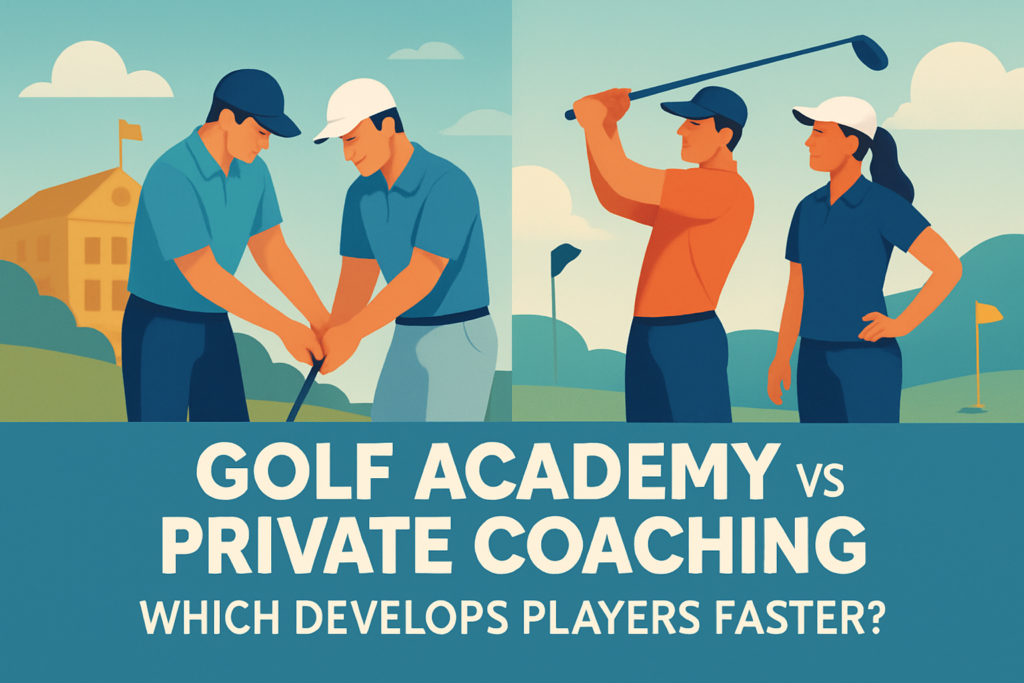
Golf development depends on structure, feedback quality, practice volume, and how well instruction matches a player’s current skill level. When golfers ask, “Golf academy vs private coaching: which develops players faster?” they usually want a practical answer, not a philosophical one. In most cases, private coaching produces faster short-term improvement for a specific player goal, while golf academies create more complete long-term development through systems, competitive environments, and multi-dimensional training. The right choice depends on age, budget, schedule, learning style, and whether the player needs immediate score reduction or a broader performance foundation.
A golf academy is an organized training environment that combines technical instruction, supervised practice, fitness, on-course coaching, and often tournament planning. Private coaching is one-to-one instruction with a teaching professional, usually delivered in hourly sessions focused on swing mechanics, short game, course management, or performance issues. I have worked with players in both settings, and the speed difference is rarely about talent alone. It comes from how often the player receives feedback, how disciplined the practice plan is, and whether training addresses the full game instead of only visible swing flaws.
This comparison matters because golf is expensive, progress is slow, and poor instruction sequencing wastes months. A beginner may improve rapidly from consistent individual lessons, while a junior aiming for college golf often benefits more from academy structure. Adult amateurs balancing work and family typically need efficiency, which can favor private coaching. Parents and competitive players, however, should also consider injury prevention, mental performance, and accountability, areas where academies often outperform isolated lessons. Understanding the tradeoffs helps golfers invest in coaching that improves scores, confidence, and long-term skill retention rather than chasing quick fixes.
What Faster Development Actually Means in Golf
Faster development does not always mean a prettier swing in two weeks. In professional coaching, I measure speed by how quickly a player turns instruction into transferable performance: lower scores, tighter dispersion, better contact under pressure, and repeatable decisions on the course. A player who gains five yards of carry but still three-putts and makes poor club selections is not developing faster in any meaningful sense. This is why the academy versus private coaching debate should start with outcomes, not format.
For beginners, faster development usually means contact quality, setup fundamentals, and enough short-game skill to enjoy playing. For competitive juniors, it means measurable improvement in strokes gained categories, tournament scoring averages, and physical capacity. For mid-handicap adults, the fastest path is often eliminating penalty strokes, improving wedge proximity, and sharpening putting speed control. According to Shot Scope and Arccos data trends, amateur scoring is influenced heavily by approach play, short game errors, and course management, not just full-swing aesthetics. Any coaching option that ignores those categories slows development.
Private coaching can accelerate progress because the lesson is tailored to one player’s movement pattern, injury history, and ball-flight tendencies. An academy can accelerate progress because the player practices in a system with supervision across multiple domains. The key question is simple: does the player need personalization most, or immersion most?
How Private Coaching Speeds Up Improvement
Private coaching is usually the fastest route when a golfer has a clearly defined problem and needs precise correction. If a player slices the driver, struggles with low-point control in irons, or loses shots from inconsistent chipping technique, an experienced coach can diagnose cause and effect quickly. Tools such as TrackMan, Foresight Sports GCQuad, HackMotion, and pressure mats make these sessions highly efficient because they connect feel to measurable reality. One strong private lesson can remove weeks of confusion from self-diagnosis.
Another advantage is adaptation. In one-to-one coaching, the instructor can change language, drill selection, and movement goals immediately based on how the player learns. Some golfers respond to external cues like target and start line; others need body-based feels or video feedback. In my experience, this flexibility is the biggest reason private coaching creates fast breakthroughs. Group settings rarely provide enough time to individualize communication at that level.
Private coaching also works well for adults with limited availability. A business professional who can practice twice a week often needs a sharp priority list, not an all-day training environment. The best coaches provide a practice plan, performance benchmarks, and follow-up through video or launch-monitor reports. That concentrated structure can lower handicaps quickly when the player is disciplined.
The limitation is equally important: private lessons do not automatically create habits. Without supervised practice, many players leave with good information but poor implementation. Faster insight is not the same as faster development if practice quality collapses between sessions.
How Golf Academies Build Complete Players
Golf academies develop players quickly when progress depends on repetition, routine, and integrated support rather than occasional correction. A well-run academy does more than teach swing positions. It combines technical coaching, deliberate practice, physical screening, mobility work, mental skills, tournament preparation, and regular performance review. That environment is especially powerful for juniors because athletic development and golf development happen together.
Academies also create volume with accountability. A player might receive technical coaching on Monday, short-game assessment on Tuesday, supervised practice on Wednesday, and on-course strategy work later in the week. This training density shortens the gap between instruction and execution. Instead of waiting seven days to discover whether a movement change transfers, the player gets repeated checks in real time. That is why many elite junior pathways and national development systems rely on academy models.
Another strength is competitive exposure. Practicing around players with similar goals raises standards. Golfers observe routines, tempo, emotional control, and work ethic from peers. That social environment matters more than many families realize. Players often improve simply because academy culture removes the casual, unfocused practice habits common at public ranges.
The weakness is that not every academy is truly individualized. Some offer impressive branding but deliver generic stations and limited coach attention. A player can spend many hours in an academy and still plateau if the program lacks personal diagnostics and measurable benchmarks.
Direct Comparison: Which Option Fits Which Player?
The fastest option depends on the player profile, not on marketing claims. Here is the clearest practical comparison.
| Player Type | Usually Faster Option | Why |
|---|---|---|
| Beginner adult | Private coaching | Builds grip, posture, contact, and confidence without overwhelming volume |
| Busy mid-handicap golfer | Private coaching | Targets scoring leaks efficiently within a limited weekly schedule |
| Tournament junior | Golf academy | Provides supervised practice, fitness, scheduling, and peer competition |
| College-bound junior | Golf academy | Supports long-term development across technique, performance, and recruiting preparation |
| Player with one persistent technical fault | Private coaching | Enables deep diagnosis and customized drills using data tools |
| Player lacking discipline or routine | Golf academy | Creates structure and accountability that isolated lessons often cannot |
If you are comparing academy programs and lesson packages, evaluate coach credentials, student improvement history, supervised practice access, technology stack, and whether on-course coaching is included. The PGA of America, Golf Digest Best Teachers, and TPI certification can signal quality, but they are not guarantees. Ask how progress is measured. If the answer is vague, development will be slower.
Cost, Time, and Performance Tradeoffs
Private coaching usually costs less upfront than academy enrollment, but total value depends on follow-through. A golfer who pays for ten lessons and barely practices may get less from that investment than a junior in a structured academy with daily supervision. On the other hand, an academy can be a poor financial fit if the player cannot attend consistently. Frequency matters because skill acquisition in golf follows repeated, high-quality exposure, not occasional intensity.
Time commitment is another dividing line. Academy training often resembles a performance schedule, not a casual hobby. That can be ideal for aspiring college or elite juniors, but excessive for recreational players. Private coaching is easier to fit around work, travel, and family life. It also allows the golfer to choose a specialist, such as a putting coach, biomechanics expert, or short-game instructor, rather than accepting one generalized program.
There are also psychological tradeoffs. Some players thrive in academy settings because shared standards keep them engaged. Others become self-conscious in groups and learn faster in private. Development speed improves when the player feels focused, coachable, and willing to fail productively during practice.
How to Choose the Fastest Path for Your Game
If your goal is to break 100, 90, or 80 as an adult golfer, private coaching is usually the fastest starting point. Ask for a skills assessment covering driving, approach play, wedges, putting, and course management. Build a 6-to-12-week plan with simple practice tasks and measurable targets. If your goal is elite junior progression, tournament readiness, and long-term athletic development, a reputable academy is often the better engine because it builds the entire player, not just the swing.
The smartest approach for many golfers is hybrid. I have seen the best results when players use private coaching for personalized diagnosis and academy-style structure for practice, fitness, and competition. That combination captures both speed and depth. Before committing, request a sample development plan, not just pricing. The provider who can clearly explain how you will improve, how progress will be tracked, and what happens if you plateau is the one most likely to help you develop faster.
Golf academy vs private coaching is not a simple winner-take-all decision. Private coaching usually delivers the fastest targeted improvement. Golf academies usually deliver the fastest comprehensive development. Choose the option that matches your goals, schedule, and readiness to practice with purpose. Then commit fully, track results, and adjust based on evidence. Faster improvement in golf comes from the right system executed consistently, so evaluate your needs honestly and start with the coaching environment that gives your game the clearest path forward.
Frequently Asked Questions
1. Does private coaching usually help golfers improve faster than a golf academy?
In many cases, yes. Private coaching often produces faster short-term improvement because every session is centered on one player, one swing, and one immediate performance goal. If a golfer wants to fix a slice, improve ball striking, sharpen wedge distance control, or prepare for an upcoming tournament, a private coach can identify the specific problem quickly and build a targeted plan around it. That level of personalization usually means less wasted practice, faster feedback, and more direct correction of errors before they become habits.
That said, “faster” depends on what kind of improvement a player is measuring. If the goal is a noticeable drop in scores over the next few weeks or months, private coaching often has the edge. If the goal is complete player development over years, including technical mechanics, on-course strategy, competition habits, practice structure, physical training, and mental performance, a golf academy may create stronger long-term results. So the practical answer is this: private coaching is usually faster for solving a specific problem, while an academy is often better for building a more complete player over time.
2. What are the biggest advantages of a golf academy for long-term player development?
A golf academy’s biggest strength is structure. Instead of relying on occasional lessons and self-directed practice, players are typically placed into a system that covers multiple areas of development in a coordinated way. That may include swing instruction, short game training, putting work, on-course coaching, fitness, mobility, skill testing, tournament preparation, and performance review. For developing golfers, especially juniors and competitive players, that kind of environment can reduce the guesswork that slows progress.
Another major benefit is feedback from more than one source. In a good academy, a player may have access to instructors, practice plans, training technology, peer competition, and a routine that encourages repetition under pressure. That matters because golfers rarely improve through technical advice alone. They improve when technique, practice volume, accountability, and competitive experience all support each other. Academies also tend to help players build habits that last, such as structured practice, goal tracking, and learning how to perform when scores matter. While this path may not always feel as immediately dramatic as one-on-one coaching, it often leads to more rounded and sustainable development.
3. Who benefits most from private coaching, and who is better suited to a golf academy?
Private coaching is often the best fit for golfers who have a clearly defined need. That includes adult players trying to lower their handicap, beginners who want a solid foundation without confusion, competitive golfers preparing for a specific event, or players who have hit a plateau and need expert diagnosis. It is especially effective for students who respond well to individualized attention and can practice independently between sessions. If a player is disciplined enough to follow a custom plan on their own, private coaching can deliver very efficient progress.
Golf academies are usually a stronger option for players who need a full development environment rather than isolated instruction. Juniors, aspiring tournament players, and golfers who benefit from routine, supervision, and consistent accountability often do better in an academy setting. Players who struggle to organize practice, who need regular competitive exposure, or who want development across every part of the game may gain more from an academy than from periodic one-on-one lessons. The best choice often comes down to self-management. If a player can execute a plan independently, private coaching may be ideal. If a player needs an ecosystem to support growth, an academy is often the better path.
4. Is a golf academy or private coach better for fixing specific swing problems quickly?
For most golfers, private coaching is better for fixing a specific swing issue quickly. A one-on-one coach can isolate the root cause of the problem, determine whether it is mechanical, setup-related, timing-based, or even caused by poor practice habits, and then create a simple correction plan. Because the coach is working directly with one player, adjustments can be tested, monitored, and refined in real time. That level of focus is difficult to match in broader training environments.
However, speed of improvement still depends on the quality of instruction and the golfer’s ability to practice correctly. A player can receive excellent private advice and still progress slowly if they do not rehearse it with enough volume and consistency. This is where academies can sometimes close the gap. If an academy provides frequent supervised practice, video feedback, and repetition within a structured routine, technical changes may stick more reliably. So while private coaching usually wins when the goal is fast correction of a defined problem, academies can be equally powerful when the issue requires a larger rebuild supported by daily structure and oversight.
5. How should golfers choose between a golf academy and private coaching if they want the fastest overall progress?
The smartest way to decide is to start with the player’s actual goal, timeline, and learning style. If the golfer wants faster progress toward one clear outcome, such as breaking 90, improving iron contact, building a dependable driver, or preparing for a club championship, private coaching is often the more efficient choice. It gives the player direct attention, customized drills, and feedback aimed at producing a measurable result as quickly as possible. This is usually the best route for golfers who have limited time and want every lesson to address their own game rather than a broader curriculum.
If the golfer wants the fastest overall progress across the full game, not just one weakness, a quality academy may be the better investment. That is especially true when improvement depends on more than technique alone. Scoring gets better when swing mechanics, short game, decision-making, physical readiness, practice habits, and competitive confidence all improve together. A strong academy can accelerate that process by creating a system where those pieces are trained consistently. In the end, the fastest path is not always the one with the most instruction, but the one with the best fit. Golfers improve quickest when the coaching model matches their current skill level, practice discipline, and performance goals.